Tampilkan postingan dengan label thanksgiving. Tampilkan semua postingan

Kamis, 22 November 2012

Busting Out of Black Friday

You know, it's bad enough that we see Christmas decorations start going up in some stores before the Fourth of July, but now, some big retailers just can't wait for dessert after Thanksgiving before trying to rack up more sales:

Retailers this year will open for Black Friday sales early enough to make shoppers choose between hot deals and hot apple pie after Thanksgiving dinner.

From Toys R Us to Target to Walmart, retailers are opening as early as 8 p.m. on Thanksgiving night.

Toys R Us announced Monday that its Black Friday will begin on Nov. 22 when doors open at 8 p.m, an hour earlier than last year.

To entice shoppers to line up even earlier, the toy retailer will give the first 200 customers at each location a free "Great Big Goody Bag" full of stocking-stuffers up to $30 in value.

"You can have your dinner, then come to our store. We all know that everybody gets burned out on turkey and football," says Troy Rice, chief of store operations, who expects stores to have lines from 500 to more than 1,000 people by the time doors open.

We think this is just a classic case of shifting consumer behavior, much like how sales tax holidays actually work. Here, instead of racking up more sales, as they might hope, U.S. retailers joining in this scheme are basically trading the timing of when their sales occur. It's not like consumers will have any more money to spend on an extra four hours of shopping....

Taking the Toys R Us promotion as an example, lining up to join in a bizarre shopping frenzy for $30 worth of "stocking-stuffers" (at Toys R Us' inflated "regular" prices - we suspect their actual cost for the items is around $10) some four hours earlier than retail tradition would dictate doesn't seem like that great a gain for the American consumer.

In the modern world, for those who just can't wait for the Black Friday shopping experience, there's no need to wait until 8:00 PM to get in on those Black Friday deals.... Or even to leave home....

The best part is that if enough consumers take advantage of the online alternatives, the other retailers looking to bust out of Black Friday will have to offer much, much better deals to consumers to try to draw them into their stores. And if doing that keeps their bottom line from going the way they might hope, they might be forced to stop the Black Friday bleedout because their sales don't justify the higher costs of having to be open longer.

And wouldn't that be a nice Thanksgiving treat!

A Thanksgiving Toast...

... from a movie that wasn't as popular at the box office as perhaps it ought to have been:

Happy Thanksgiving!

Selasa, 20 November 2012

The Illusion of Prosperity for U.S. Turkey Producers

It is very hard to make money in the turkey business.

In fact, low profit margins are the main reason that Smithfield Foods (NYSE: SFD) sold off its 49% stake in Butterball, the top producer of turkeys in the United States, for $175 million back in September 2010.

But U.S. turkey producers would appear have been on a tear since 2003, collecting more and more revenue in almost each year and now having more than doubled after having had mostly flat incomes in the 14 preceding years.

Annual Turkey Farm Income (All Producers), 1990-2011

That increase in revenue becomes even more exaggerated when we consider the falling volume of turkeys produced over that time:

Number of Turkeys Produced, 1989-2011

Calculating the average income collected by turkey producers for each turkey they produce, we find that the average revenue collected per turkey has been rising at double-digit growth rates since 2003.

Average Farm Income per Turkey Produced, 1990-2011

And yet, "Big Turkey" is struggling to profit.

The only way this situation can exist is if the cost of producing turkeys in the United States to be rising at similar rates. Or more specifically, if U.S. turkey producers are directly passing on their higher costs of production to U.S. consumers on an almost dollar-for-dollar basis, which we can safely assume is the case given what we observe and the razor-thin profit margins for U.S. turkey producers.

So our question is what changed after 2003 that resulted in driving up the cost of producing turkeys in the United States in nearly every year since?

To find out, we began by looking at the main factors that can affect the cost of producing turkeys for market.

According to the University of Missouri's agriculture department, the cost of turkey feed can represent 70% of the cost of turkey production. With such a large share, we focused solely on this particular factor for our analysis.

Turkey feed typically consists of two main ingredients: soybeans and corn. Here, we observe that soybean prices suddenly spiked in 2003, then fell back to their pre-spike level in 2004 before beginning to increase in 2006. Meanwhile, the price of corn mostly held level until 2005, when it began to skyrocket in response to the U.S. federal government's increased ethanol fuel mandates - dipping only with the Great Recession in 2010.

The combination of the 2003 soybean price spike (which would be fed to turkeys in 2004) and the sharply increasing price of corn after 2005 would appear to account for nearly all of the increase in the cost of turkey production after 2003. Of the two, corn prices would appear to be the more significant driver, in that a larger and larger share of U.S. corn production has been required to be consumed to produce ethanol for use in motor vehicle fuel by the U.S. government over the years since 2005.

Percentage of U.S. Corn Crop Consumed by Ethanol Production and Corn Price per Bushel, 1980-2012

We should also note the role of the federal government's ethanol mandate in displacing other crop production, reducing supplies of those other crops while simultaneously increasing their costs at market.

And thus we discover the reality behind the illusion of prosperity for U.S. turkey producers. They've never generated more revenue, but they've never struggled so much to profit so little either.

That's the big reason why the industry isn't growing. The University of Missouri reflects on the role the industry's production cost increases have had on the state of the turkey business:

While such increases have boosted production costs of white meat and giblets, retail price pressure isn’t letting producers pass much to the consumer. Turkey eaters have reacted to price increases of almost eight percent over 2009 by eating more holiday ham and Thanksgiving pizza.

According to the US Department of Agriculture, turkey output dropped from 5,663 billion pounds in 2009 to 5,587 billion pounds last year, about a one percent reduction. Stocks of frozen whole birds also fell. Between September and October of last year, six percent fewer turkeys found themselves in freezers.

Grocers have tried to keep turkey prices low, even selling the birds below cost to attract holiday customers who load shopping cars with other goodies. With little opportunity to increase prices, producers have to eat higher costs to remain competitive.

In response, the turkey food industry now processes more meat into TV dinners, turkey ham and breasts, but this is only keeping pace with the decrease in holiday whole bird consumption. Annual consumption per capita has remained flat-lined for 30 years – about 16 pounds in some form, including Spam Turkey.

It is very hard to make money in the turkey business.

Senin, 19 November 2012

U.S. Turkeys: Bigger than Ever!

It's Thanksgiving week once again here at Political Calculations, where our tradition calls for us to put aside everything else we're working on and celebrate the most American of all national holidays for an entire week.

We're kicking off this week's holiday festivities by considering just what "Big Turkey", the conglomeration of the biggest turkey producers in the U.S., are seeking to put in the center of every American dining table on this holiday: a big turkey!

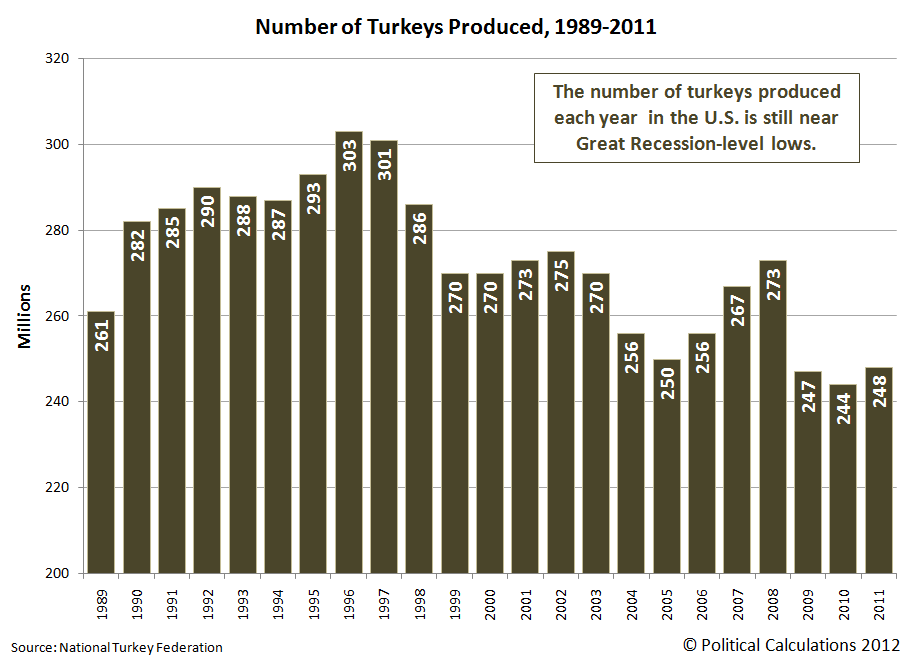
But first, let's see just how many turkeys we're talking about. Drawing upon statistics collected and published by the National Turkey Federation, we put together the following chart showing how many turkeys made it from farm to table in each year from 1989 through 2011:

Number of Turkeys Produced, 1989-2011

Here, we see after peaking at 303 million birds in 1996, which coincided with the height of the low-fat diet craze, the number of turkeys produced each year fell off to range between 250 million and 275 million through 2008.

However, the aftermath of the Great Recession took a big bite out of U.S. turkey production beginning in 2009, sending annual turkey production below the 250 million mark.

You would think then that America's turkey farmers are producing less turkey today than at any time since 1989, the first year for which we have annual turkey production figures.

You would, of course, be wrong. In reality, 2011 marked the fourth-highest year on record for total amount of turkeys to go to the market, as measured by their live weight:

Total Live Weight of Turkeys Produced, 1989-2011

The only way that mathematically works is for the size of turkeys produced in the U.S. to increase pretty dramatically. Doing the math, we find that's exactly what has happened!

Average Live Weight of Each Turkey Produced, 1989-2011

On average, we find that the average live weight of a turkey produced in the United States has risen from 21 pounds per bird in 1989 to reach 29.5 pounds today.

That's a 41% increase in the weight of a live turkey produced for market in the U.S. in the last twenty-three years. To help put that increase in perspective, the largest "heritage" or wild turkeys will weigh in at just 16 pounds per bird.

So that's what "Big Turkey" has been up to over much of the last twenty three years (and longer!) In our next installment, we'll see just how much money "Big Turkey" makes on each one of those birds!

References

National Turkey Federation. Turkey Statistics. Accessed 12 November 2012.

Jumat, 25 November 2011

Thanksgiving 2011: What to Do with the Leftovers?

It's the age old American dilemma of what to do with the remains of the bird following the Thanksgiving holiday, while not doing any more to continue sending your Body Mass Index in the wrong direction. This year, we're featuring Cooking Light's recipe suggestions for what to do with all that's left behind!


Turkey burnout is insidious. One minute your bird is beautiful and fragrant, floating majestically to the table, its crisp skin glistening. You could eat every last bite all by yourself. But in a twinkling―or, to be exact, after a couple of servings―the feast loses its luster. By the time the candles have been snuffed, the good china put away, and the wine glasses washed, what's left of your 20-pounder looks like just one more responsibility. Worse, the week ahead looms with the dreary prospects of turkey hash, turkey supreme, and turkey a la king. For a moment, you consider getting a really big dog.


Not to sound unsympathetic, but snap out of it! Strip that bird straightaway with a sharp knife, and quickly refrigerate the white and dark meat in separate airtight containers (for up to five days or freeze for up to two months). Don't labor over the bones and fatty "parson's nose," telling yourself you'll boil them down into soup stock―you know you won't be in the mood for that anytime soon. Toss 'em, and be done with it. Feel better? You should. You've cleared the slate for a fresh approach to this versatile, forgiving meat and stocked a ready-to-use supply.


These recipes give your leftovers a new life, without ever resorting to a turkey-noodle surprise.


Cooking Light's recipe suggestions include:


Enjoy!

Kamis, 24 November 2011

Happy Thanksgiving!

We couldn't resist sharing the following image, stolen from here, which brings our love of food, math and Thanksgiving all together:


C/D = pi

Have a Happy Turkey Day!

Rabu, 23 November 2011

Thanksgiving 2011: Eat, Fry, Love

What happens when State Farm gets together with William Shatner to create a "turkey fryer fire cautionary tale"?


If you're planning to deep fry your turkey this Thanksgiving, the answer is public service announcement magic!


Have a Happy Thanksgiving!

Selasa, 22 November 2011

The Post Turkey Apocalypse, Part 2

How can a 1.2% decline in the number of turkeys produced result in a 21.9% increase in their price?


That's the question we're tackling today as we continue to survey the post-Turkey apocalypse world. Here, we're going to look at the pre-apocalyptic world of 2007 and compare it with the post-apocalyptic world of 2010. The animated chart below shows what we find when we look at the production of "Big Turkey" (aka "America's 20 largest turkey producers") in before and after snapshots:


U.S. Turkey Producers: Live Weight of Turkeys Processed, 2007 and 2010


In this chart, we can see that turkey production has largely just shifted among the 20 largest producers in the United States between 2007 and 2010.


In fact, if we add up the number of pounds of live turkeys processed by each of the Top 20 turkey producers, we find that this figure increased for "Big Turkey" from 2007 to 2010, from 6,858 million pounds to 6,971 million pounds, an increase of just 1.6% over those four years. So clearly, "Big Turkey" isn't responsible for the decline in the number of turkeys produced in the United States.


But the decline in the number of pounds of turkeys processed by "Combined Smaller Producers" is! Here, we find that these smaller turkey producers account for a decline of 568 million pounds of annual production between 2007 and 2010, as their combined total fell from 704 million pounds in 2007 to 136 million pounds in 2010.


Basically, the fallout from the 2007 recession significantly hurt small turkey producers who, in addition to having to deal with reduced demand for their products from people whose economic livelihoods were most affected by the recession, have also been hit by rising costs of production, especially in the form of higher prices for feed corn, thanks to the government's increasing ethanol mandates.


This double whammy is responsible for hurting the ability of smaller turkey producers to remain in business, as many have been squeezed out of the market for turkeys altogether. And in the absence of competition from those smaller businesses, "Big Turkey" has the ability to significantly hike its prices to American consumers, most of which goes to cover their own increased costs of operations.


That situation could be easily reversed. It only takes a President who pays more than lip service to the needs of typical Americans and small businesses, instead of being out to stack the deck against them!

Senin, 21 November 2011

The Post Turkey Apocalypse, Part 1

It's time once again for Political Calculations' week-long celebration of the most American of American holidays: Thanksgiving!


But this year, we're looking over a grim scene following the aftermath of what we described as the Turkey Apocalypse last year. Has the situation for America's Thanksgiving holiday gotten any better in the following year?


Number of Turkeys Produced in the United States, 1989-2010

Let's start by looking at the number of turkeys produced in the United States through 2010. Here, we find that the number of turkeys fell by 3 million, or 1.2%, to 244 million, the lowest level recorded since 1989, the year for which our National Turkey Federation first provides data.


That's a small drop compared to the previous year's decimation, which was the largest ever recorded over a single year period of time.


Let's next look at how much America's turkey farmer's are getting per turkey.


Average Production Farm Income per Turkey, <br />With and Without Inflation, 1990-2010

Here, after looking at both nominal and inflation-adjusted prices, we find that U.S. turkey producers raked in more money per turkey produced in 2010 than ever before, with the dollar amount of income from each turkey produced rising in real terms by $3.22, from $14.69 to $17.91. That's a 21.9% year over year increase!


Using our Supply or Demand tool, the combination of that apparent increase in price with a decrease in quantity tells us that the price of turkeys has increased in 2010 due to a relative decrease in their supply.


But how can a 1.2% decline in the number of turkeys produced result in a 21.9% increase in their price? We'll tackle that question in our next Thanksgiving week post!