Tampilkan postingan dengan label materials light. Tampilkan semua postingan

Selasa, 17 September 2013

Where You Come From - An Inexhaustible Lesson Topic

I come from Kansas City, well better said I grew up in the suburb of Overland Park, Kansas.  When I meet most people in Europe, neither ring many bells.  Kansas City is one of the non-descript cities of a few million people which litter the middle two-thirds of the country.  In fact, if you landed in KC, Cincinatti, Minneapolis, Dallas, or Pittsburgh you could forget where you are because they are all the same.  This is 'fly-over' country which many people only see from 36,000 feet.

Of course, the residents of these place would deeply disagree with this statement and could talk at length about the unique features, culture, and legends of their hometown.  I distinctly remember a taxi ride in Springfield, Missouri in which the cabbie insisted on giving me 100 years of the city's history in 10 minutes.  He even stopped the meter to take me past the next performing arts center.  It would not be any different in Omaha or Louisville.  I found the same in Glasgow and Liverpool.

But with the invention of the internet and the flattening of the world, these places have generally lost their uniqueness and developed into carbon copy cities with nearly identical cultural traits.  I bring up this point because much the same has happened here in Germany as well.  Local variety has been diminished by global sameness.  But superstores and chain restaurants are boring.  Because they must attract the global masses, they avoid risks and anything which might offend the local consumers.

I find that local flavor, local traditions, and local culture make for highly interesting lessons.  I like discussing the exceptionalism of our region.  The students are proud of their perceived uniqueness.  I believe this also has a distinct business function.  Many business small talk conversations revolve around such topics.  They are useful in business.  It gives the parties the chance to talk about something they know and like.  But it also allows them to get a sense of the values, motives and background of the interlocutor.  These topics leave space for stories and humor, but also provide a certain distance from dangerous personal opinions.

It is interesting to see, for example, how foreign trips are arranged.  Guests are often hosted in a hotel or neighborhood which has retained traces of the local culture.  Guided tour events are arranged to give guests a short journey through the traditions and legends of the region.  There is always the desire to give the guest the 'authentic' experience.

With this in mind, here are a few discussion topics which I often use in training.

  • How did your hometown get its name?
  • Who is the most famous person from your hometown?
  • Is there anything from your home which is 'world famous'?
  • Tell me about the special food from your home region.
  • What unique traditions does it have?
  • Does your hometown have any 'rival' cities?  Why?
  • What are the most famous buildings in your town?  What happened there?
  • Tell me about a festival you have every year.  Why should I go?
Google maps and street view are great resources for this.  I also find that these topics can often be captured and turned into skills training.  The simplest is something around tourism but I try not to use this too often and instead look for something more creative.  For example, I once had a student from Herzogenauerach here in Germany.  The most famous story about this town is of Adolph and Rudolph Dassler who founded Adidas and Puma respectively.  The two brothers fell out and never spoke to each other again.  But this little town is still the headquarters of these two sportswear giants.  I took the story (which all are familiar with) and set the task of negotiating a merger between the two firms.  Their goal was to 'heal the wounds' of the past.  The students did some internet research (due diligence) to gather some financial data, worked in teams to prepare for the negotiation, and then held the meeting.

This is just one example of how these lessons can turn out.  I will be heading to Kansas City next week for a short trip to say hello to friends and family, but at the same time I will be sniffing the winds of cultural change in my hometown.  Perhaps I will find a few lesson ideas along the way.

So, I encourage you to look into where the students come from and capture these topics to develop engaging and personal lessons.  It works for me.  But sadly, we never did get Adidas and Puma back together... the loyalties simply run too deep.


Rabu, 04 September 2013

I Only Have One Lesson Plan

Over the past several years, I have been asked numerous times to share lesson plans with other trainers.  I have no problem with this and I think it is great.  I think Claire Hart's blog (please keep it up Claire) is simply magnificent, as well as the work of 'lesson plan gurus' like Phil Wade.  I would love to be able to produce such clear and structured ideas which support the students.  So, for the past several months I have been trying to write posts about lesson plans I use in class.

The problem is I don't have lesson plans.  Or better said, I only have one lesson plan.  I recently filled up a my teaching notebook (I use a traditional spiral notebook) and I began transferring the information I needed for continuity into my new one.  Since mid-July I have had many great lessons and some which were not so good, but they all started with the same plan.  The differences were the choices I made during the lesson.

This became readily apparent to me a few weeks ago.  In one training project, I run two technical English mini lessons (45 min each), one in the morning and one in the late afternoon.  Each lesson has the same plan but they never cover the same thing.  Sometimes both are great, sometimes one is disappointing.  For example, I wrote down "Examine the electrical system of my car" in my notes, but the only commonality between the lessons were the words fuse and circuit breaker (and the difference + collocations).

So, here is my lesson plan.

Click on the flow chart to enlarge.
Let me walk you through the steps.

Step 1 - The Students Start Talking

I don't use lots of scripted warm-up activities.  In most cases, my students have 60-90 minutes in class each week and they want to talk.  Sure, there are some confidence issues at first, but it doesn't normally take long for them to come in and start chatting.  Indeed, teacher input at the beginning or framework materials can direct the topic and in some cases, I have a specific pathway to follow.  Either I have announced (or we decided) the focus of the lesson beforehand, or I have certain needs which must be covered in a specific way.

If they do not start talking right out of blocks (or the class is consistently dominated by some) I may use targeted questioning to manage the discussion.  But mostly, I want the learners to talk about themselves and ask each other questions.  Usually it works easily, but I may need to provide structure (e.g. pair discussions) to assist.

Here are some simple examples of framework tasks or targeted questioning if the students don't start talking.

  • Draw a picture of your desk, workplace, apartment/house, etc.
  • What did you do yesterday evening when you got home from work?
  • Have you ever...?
  • What do you think about...?
  • I'm curious, why...?
  • Let's have a short update meeting, give us a one minute update on your current tasks/project.
Of course, the possibilities are endless.  In most cases, I consider this phase complete when the conversation moves from teacher driven to learner driven (either in topic or dynamic).

Step 2 - What is the topic?

At some point, I capture the topic and start to drive the conversation in a productive direction.  I have yet to find a topic which does not afford a variety of lessons.  Even something seemingly routine and mundane can be manipulated to achieve great results.  But some connections are clearer than others.  For example, sports leads quite easily into finance.  Depending on time, I will need to capture a topic quickly and work toward a focus.  Prescribed warmers, framework materials, and immediate input activities (like an article) will, of course, help drive a topic, but I prefer to let them express themselves freely.  I tend to remember that they have just left their desks and are looking forward to a few minutes of relaxation.  Constraints on the conversation may only cause negative feelings.  I am prepared to leave 15-30 minutes to finding a topic.

Step 3 - Determine the focus of the lesson

Once the topic has been captured, I will select a focus of the lesson.  This is not a lottery.  I have genuine expectations for the learners to improve and I have a duty to the customer to provide effective training to improve job performance.  I will quickly weigh three factors in determining the focus of the lesson.  Part one are the needs (and/or lacks, as Jeremy Day calls them), part two are the expectations for the training and lesson, part three is lesson continuity.  Depending on the situation, I will balance these factors.

For example, if it is an unusually stressful time in the company/department, it may be best to limit the demands of the lesson and take what you can get.  If the company goals trump what the learners expect then the training will have a different focus.  But note, this does not mean changing the topic, simply driving the lesson toward a tangible goal.  So, I have seven types of lessons which also determine teacher talking time and the quantity of input.  I prefer to continuously change the focus of the lesson and I feel uncomfortable (as do the students) when the class repeatedly follows the same pathway.

Step 4 - Focus on Language

Once I have selected the focus of the lesson, I have taken control of class.  In other words, 'We are going somewhere, and I'm going to take you there.'  The question is then, how are we going to get there?  What is the method?  The method often depends on my calculation of resources.

Here is a summary mind map of the resources I consider.
Click on the image to enlarge.
Part of this is a complete understanding of what resources are available.  As we remove each resource from the equation, we constrain our ability to design effective exercises.  If you have everything mentioned above, the activities are endless.

This is also where methodology comes into play.  For example, I may use a TTT, PPP, or guided discovery method to teach grammar.  I may focus on collocations for vocabulary.  Sometimes I even switch to the Silent Way mid-lesson.  In some cases, I may even get the idea that we should just keep chatting and have a mainly conversation class punctuated by occasional feedback interludes.  But this is not the default setting of the lesson and I'll often clarify this with the learners, "I get the feeling everyone is a little tired from work, is it alright if we just keep talking and I'll give you some feedback?"

From this methodology and resources balance, we'll have role plays or listen to a recording and dissect the language.  It all depends on the three factors.  This is why no lesson is the same.  Note:  I almost always ask the learners to design their own role play.

Example Lesson

A 90 minute lesson with tax consultants (B1-B2).  They had talked about the need to understand contracts in the previous lessons.  The learners have different offices, some work in the consultancy offices and some have offices embedded with a major client.  These students travel to the consultancy offices for the lesson.  One of them arrives in class with a giant stack of papers (possible resource!).

I am curious about the stack of papers and she tells me that it is training material in German (damn!) about recent tax law changes (topic?) and she has to learn it.  I ask if she feels 'out of the loop' (boarded) because she's away from management.  After a few minutes the conversation centers around the 'milk issue'.  When you work at the consultancy, coffee (plus milk and sugar are provided), but they have conflicts when using the milk and sugar at the client (coffee is negotiated and paid by the consultancy).  I recognize a prime a topic here (free coffee and the office kitchen are perfect for a variety of lessons).

I capture the topic and set a focus.  "That is interesting.  Okay, today in the lesson we are going to write a contract for the use of the kitchen and the 'milk issue'."  I have several resources.  First, the learners have probably read more contracts than I have.  I know register.  We have the internet so template/example contracts are searchable but printing is difficult.  I have a whiteboard with five markers.  Four are dry, so I have one color.  One learner has paper but no pen (I have an extra).  There are four students so pair work is possible without an obtrusive trainer.  I don't have a private space so while a negotiation might be nice, there is no real place for the two pairs to prepare.

I elect for a scaffolded approach to the productive skill (well, it is actually a receptive skills lesson through producing the language).  I say, "Okay, before we write the contracts, I'd like to give you a little support because contracts use a specific language."  I have 60 minutes left so I am looking at a limited scope, mainly focusing on word choice when changing register.

Input Segment

I point out the word shall.  Shall has different meanings between everyday British English (which the learners had in school) and contracts.  Shall = should + will in everyday English, but must in contracts.  A big difference.  I bring up a template contract (actually my rental agreement for my condo in Washington DC) to show how shall is used in contracts.  This reinforces the point.

Discussion Segment

I point out that shall is a signal word in contracts and I rely on their experience in contracts to find more (and to gauge their ability).  I am looking for words like guarantee, continuous, unobstructed, etc.  They offer a few, I offer praise.  We clarify, with the learners explaining meaning, and move on.

Eliciting Segment

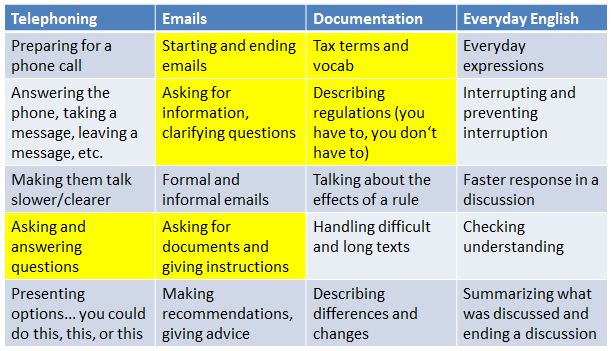
My estimation of their language is that they are fairly proficient in socializing and that they struggle when they have to increase their professionalism.  On my list of needs is switching register and tone to speak to clients.  If you have read my blog before about need analysis, I create a table of needs instead of a linear pathway.

This topic and focus creates a great opportunity for addressing word choice to affect register.  I pull up an old PowerPoint presentation (actually, I disconnected the computer and pasted the table into the client's template) which had everyday informal words on one side and a blank column for formal words on the other.  For example, give = provide (this approach was inspired by the The Business coursebook from MacMillan).  I wrote down in my notebook that we should look at the Open University video on French influence later.  I also wrote the word 'Leo' because Leo Selivan has covered the various lexical layers of English in his talks.  The students are tasked with giving formal words with similar meanings.  The pair compare results and I add a few missed words (e.g. get = obtain, acquire).

Production Segment

Okay, I have 30 minutes left and it's time to get writing.  The students write the contract in pairs, I check it over their shoulder for accuracy, they read it aloud to the group.  I board key words like aforementioned.  We rephrase a few sentences by comparing and contrasting.

Done... its all about milk (which costs €.52/L but has an immense emotional value).

Step 5 - Transfer Design

I have become convinced that it is important to explicitly highlight how the lessons can be applied to the job.  During my talk at the BESIG conference Stuttgart on need analysis I said, "The learners don't know what they don't know."  I similarly believe that "The learners don't know how to use the lessons unless you tell them."  I like to end the lesson with a short reflective session on how the vocabulary, skill, etc. can be used in their job.  This is tantamount to commitment and I often record this in my notebook.  I may check up on this transfer in a later lesson.  In other words, this is part of the continuity factors when deciding the focus of the lesson.

Step 6 - Check on Learning

I like to have a review session at the end of the lesson.  In general, I expect that if I teach it once, they learn it.  Of course, this is completely unrealistic and I did not start out this way.  But I found that the students themselves felt guilty if they could not give the learning objectives of the previous lessons and said "Ach Scheiße!" if I corrected them on a mistake we had covered.  So, I expect the highest of standards.  If it is written on the board or sent via email in a PowerPoint... it should be learned.  I am understanding, but I don't let them off the hook or justify their non-performance.  If it is something I have covered repeatedly with one learner I will put them on the spot in front of the class.  Granted, it is wrapped in humor and rapport.

But the last phase is to check that they learned.  They will often say that they will apply the lesson (response bias) but fail the quiz at the end.  My most common method is to remove all supports (erase whiteboard, turn off projector, put away notes) and ask them to summarize the lesson.

Here are some example questions:

  • "Joachim, give me one word you learned today."  Then go around the class... it becomes progressively harder.  Periodically challenge other factors of understanding (register, spelling, etc.)
  • Use higher cognitive levels of understanding (Bloom's Taxonomy of verbs will help you devise questions).  "Sophie, what is the difference between Thanks for calling and I appreciate your call?"
  • "Okay class... I've erased the board.  Andreas, please come take the marker.  The class will help you recreate everything on the board."  

So, that's it.  That my lesson plan.  I wish I could tell you that I control what happens in every lesson, but I am simply a guide to the language.  I can only selectively direct each session to meet a specific need or expectation.  I would hesitate to say my approach is dogme because my default setting it attain maximum value, which I question about totally free-form teaching.  I still follow traditional teaching methods like task-based learning, but within the context of learner content.

I cannot give you lesson plans... I can only give you lesson reports.  They are quite different.  Sorry.


Senin, 13 Mei 2013

Giving Learners Control of Skills Training

As I am sure everyone is aware, there are two types of grammar:  prescriptive and descriptive.  Prescriptive is a set of rules which standardize grammar and determine whether something is right or wrong.  Descriptive is a study of language as it actually is used to deduce a set of grammatical commonalities.

It looks like most teachers agree that teaching the descriptive grammar is more useful for the learners as communication trumps some arbitrary form of correctness.  Why, then, are we teaching prescriptive skills?

Prescriptive Skills

There is no one right way to lead a meeting, give a presentation, engage in a negotiation, write an email of request, and so on.  Research on discourse and the field of pragmatics help show something we already know... we change our language as we perceive the situation.  This goes way beyond register and whether something is formal or not.

Some have argued that language teaching should be more contextualized to ensure pragmatics are included and students gain the skills needed to alter their language to fit discourse.  This makes perfect sense.  But sometimes I see materials which have "Key Phrases for Meetings" or how to write a formal complaint.  This, however, adds a certain set of prescriptive rules for communication which may not always be appropriate.

A classic example of this are dialog structuring activities which allocate select phrases to students A and B to be used in a 'language flowchart'.  The context is provided through detailed role-plays and case studies.  But often I feel that these violate my "Train as you Fight" motto I picked up in the military.  In other words, the training context should be as close to real-world conditions as possible - modified only for ability.  This same approach is echoed repeatedly in other training fields when they discuss transfer design.

"Take this three times a day to cure bad meetings."
Descriptive Skills

So, if the intent of skills training is to introduce as much realism as possible, it is best that it includes contextual concerns.  This includes culture and relationship of the interlocutors, the communication conventions (e.g. structure, templates, etc.), intent, and desired perception.  When we add all of these together, it is clear that there is no one best way.

The problem is the complexity of all this.  How are we supposed to find resources for all of this information? How can we possibly create a list of phrases for meetings in every context?  This would be simply unworkable.  No doubt we as a profession have tried.  One day, I would like to compile all the useful phrases for small talk in my library and see how we are doing.


Hard to describe but it looks like art to me.
The answer is two-fold.  One, we have to accept complexity.  We have to understand that by describing something we inherently limit it.  By describing an effective presentation, we make all the other methods wrong.  So what happens if one week we do presentation training and the next week we watch a TED talk?

The second part of the answer is accept that we don't know everything.  The key to skills training is the students themselves. They can quickly offer all the contextual information we need and tell us what success looks like.

Elicited Rubrics

A key element of performance-based training is the assessment rubric.  I have written a bit about performance assessment in two earlier posts (lessons from the military and assessing quality).  Judith Mader has done extensive work on performance-based assessment in the field of pre-experience learners.  She's even written a book about it.  At the heart is designing a list of criteria and then evaluating whether the student met each of those criteria during the task.

For example, a very simple performance rubric might look something like this:

Note:  This is prescriptive...
So, my goal in skills training to develop a rubric which will not only assess the training event, but also give the learners a series of steps to successful fulfill the task.  It also provides ample room for teacher and peer feedback.  These rubrics can be extend to the right to include grading scales and exact performance measures.

Here is an example from a university for a written paper:


So, how do we create rubrics without assuming too much about context?  The answer is sitting right in front of us.  They know the interlocutors.  They know the context.  They know what they like and don't.  Let's ask  them.  By having an introductory conversation about the skill in context we can define the performance criteria together.  Furthermore, they have a stake in the process and are more likely to provide constructive feedback and transfer the skill to the workplace.

Lesson Idea 1 - Email to Request Information

With this B1-B2 class I had already conducted a needs analysis based on the communicative event, so I knew that requesting information from fairly distant colleagues was a common task.  The lesson was only 60 minutes so I needed to keep the frame fairly small.

I started the lesson with 10 minutes of small talk and catching up.  Then we came to the point.

Today we are going to write an email to request information.  You have just received an Outlook invitation for a meeting in Munich on May 29th (Munich is about 2 hours away).  You recognize the name of the organizer, but you don't know him.  We are going to write an email to find out more about the meeting and if we should accept.  I haven't included more information because I want you to fill in the details.

Then I created a mindmap on the board with "Request for information" in the middle.  Above it I wrote "Preferred" and below I wrote "To avoid".  We started by discussing things that should be included in the email (preferred).  We then added items which should be avoided.  As the moderator of the discussion, I made sure is encompassed linguistic as well as topical issues.

Then, they wrote the emails and I wrote one as well.  I ran to the copy machine and make copies for everyone.  While they were reading I marked the emails for corrections.  We then compiled phrases used by the various students to be used later.

This simple mindmap exercise can be done with any communicative event.  What makes a good meeting chairperson?  What should they avoid?  What is good when describing a presentation graphic?  What should we not do?  The teacher can help break it down to sentence level if needed.  But it is important that they provide the contextual information.

Lesson Idea 2 - Presentation Rubric

Above you have seen a prescriptive rubric for a presentation introduction.  I have also made such charts with the class.  Below is a lesson example from a tax consultancy.

Today we are going to practice starting a presentation.  You have been asked by the company to give a presentation to your client about new regulations on value-added taxes in Germany.  You will have to inform them about the changes so that you can file the VAT returns quickly and correctly.  Today we will practice only the introduction of the presentation... what you will say at the start.  So, let's start by talking about what is important to have in this introduction.

After the conversation, the rubric looked like this.


So, as a trainer, I knew what to listen for.  In this case, I actually put this rubric on the projector (I had a flipchart to brainstorm and projector to record) so that the small groups could give peer feedback.

Conclusion

At the end of both of these lessons, I left ample time for feedback and a chance to discuss what had happened during the training.  These rubrics can also be used for review or building to a larger task.

Prescribing a most effective way is not always bad.  Indeed, I use it often for certain groups.  For pre-experience learners there is little alternative.  For wide ranging need sets, it is sometimes acceptable.  And I will also use it for remote training (e.g. eLearning and email coaching) where feedback is not possible.  But this type of training is the lowest common denominator.  It should be better.

The point is, if we profess to know the best way to perform a business skills, we place our learners at a disadvantage.  Just like a prescriptive grammar teacher creates students who cannot operate in the real world, we can do the same with skills.  We need to accept the complexity of our learners' world, acknowledge that neither we nor our resources know everything, and let our students define the context.  Using the communicative event analysis provides us the tool for developing the framework materials, but it is up to the learners to take that step further to outline the rubric.  Naturally, the trainer is contributing every step of the way, but leading by questions... not by prescription.


Selasa, 19 Maret 2013

Easter for Engineers

I work with many engineers:  software, mechanical, and electrical.  It is truly an honor to work with them and watch them tackle challenges.  They have a distinct approach and they love attacking problems.  Never do they throw up their hands and say, "I don't know!" or give up on a challenge.

So, for today's lesson I decided to try a fun event to really get them talking and working.  On Dave's ESL Cafe, he has a lesson plan called "Protect your egg" and I thought it was perfect for Easter.  It appears the lesson is originally from the book Business English Recipes by Judy Irgoin.  Sadly, the book is not available digitally so I haven't reviewed it.

The basic lesson is simple.  Pairs are given string, tape, two balloons, two pieces of A4 paper, and a raw egg.  The task is to construct a device which protects the egg when dropped from arms length.  The only rule is that the egg must fall freely and cannot be lowered to the ground with the string.


For the A2 learners we started by looking at phrases for making and responding to suggestions.  For the B1 group, the support was eliciting and boarding phrases beforehand.  For the B1+ and B2 learners, they were not allowed to use the word "I".  For the weaker group I helped them with a few phrases, nothing amazing... just as reference for during the activity...

Perhaps we could...
We might be able to...
It seems/appears that...
How about -ing...
One idea is to...
What if we [past]...?

Then they were off to the races.  I stepped back and let them at it, assisting only with slight corrections and unobtrusively boarding lexical gaps.  In one group, I called a short timeout during the planning/building to replace the word "fix" with better options like "attach", "secure", "stabilize", etc.

Here is the winning design from the day...


The egg was suspended with strings in the center of the tetrahedron.  The bars are made of rolled paper.  In total, we dropped nine eggs.  Four did not survive the fall intact and we broke two during construction... bring paper towels.

An added benefit of the lesson was that it has helped draw the students to their new course site.  I have spent considerable time building material and creating the website.  Of course, adoption takes time.  To pull interest, I took pictures of the them holding their designs and then posted a recap of all the projects at the end of the day.  They were intensely curious and nearly everyone logged in within an hour of sending the email notification that it was uploaded.  For many, this was their first login to the site.

Also, the restriction on the stronger groups by outlawing the word "I" was outstanding.  It eliminated the "I think, --- Well, I think" exchanges.  Afterwards, we discussed how avoiding "I" generated more ideas and dialog because the suggestions were no longer personal property.

So, a wonderful day with lots of laughs and great language.  Thanks to Judy Irgoin and Dave's ESL Cafe for creating and sharing this lesson for my engineers.  Have a Happy Easter!

PS - My apologies for the blog slow down.  I am working on a large CPD project for BE Trainers I hope you will enjoy... more to follow.

Jumat, 23 November 2012

Two Easy Peer Feedback Methods

Peer feedback can be extremely valuable in the BE classroom, especially when it comes to communication skills.  There are two reasons for this.

First, my learners are typically all in the same company and/or department and have a better grasp of the conventions within the discourse community.  Second, the learners have years of experience and training in various areas which they can draw upon to give feedback.  For example, several of my learners include project managers who have taken part in many training sessions on relationship building and giving feedback.  It is great to spread that knowledge.

Of course there are many other great reasons for constructive peer feedback, but there are also dangers, too.  Without direction and some limits, peer feedback can be overly positive or only highlight shortcomings.

For example, here is some peer feedback I received on a proposal I wrote for a university class.


·         Your introduction is very wordy.  I would consider consolidating some of the paragraphs and cut back on so many words.  Once you write the Letter of Transmittal you will realize most of what you wrote in your introduction will also be in your Letter of Transmittal.  Your introduction should be concise and to the point. You use too much detail for the reader in the first two paragraphs, which led to repeating most in the body of your proposal.  
·         Your title page doesn’t include who you ultimately want to read your proposal.  In our textbook on page 289 the title page lists who it is prepared by and who it is prepared for.  The prepared for individual will also be the name you address your Letter of Transmittal to. 
·         I would also consider spelling out what R&D because readers may not understand the acronym. 
·         You are also missing table of contents, which is a requirement for the report.
·         When using visuals you should name them in the proposal i.e. Figure 1, Figure 2, etc. Also if you pulled your illustrations from somewhere else you need to cite those as well. 

Hardly motivating... did I do anything well?  By the way... I did fine on the final assignment.

A Simple 3-2-1

I like to use a simple 3-2-1 feedback format for peer feedback.  I simply write on the board prior to a presentation, meeting, email, etc.

Write:
3 things they did well.
2 things they can improve.
1 thing you want to take and use in your presentations, emails, etc.

Then after the simulation/role play, I give them time to fully write out their feedback for the person.  I do not read them and let the learner look at them without pressure after the lesson.  Typically, the learner will come back the next week and thank their classmates for the excellent responses.  Then when we are giving class presentations, all participants are more likely to give complete, honest, and constructive feedback because they will receive the same in return.

Email Workshops

A second method for extensive peer feedback is email workshops.  I will set up pair groups and give each pair the task to write an email.  Each situation will be similar.  Note:  I will change the emails based on the target function.

For example: (the learners are told to fill in details to fit their job/situation)


Group A
  • To introduce yourself to a new business contact.  You will be working together in the future.
Group B
  • To follow up on a conference.  You met the person for the first time and talked shortly, exchanged cards and agreed to stay in touch.
Group C
  • To get in touch with a former friend / colleague.  You were close before but lost touch after several years.  But now you may need some help from him / her.
Then, the pairs compare and contrast their emails based on subject line, greeting, opening, structure, opening for discussion/response, closing, formality, and length.

Then I will have someone run to the copy machine and make copies for everyone.  Note: I give them an email template on A4 paper with all the top fields and a writing area.

Then the members of the three different groups will read the other emails.  While they are reading, I will mark the emails for accuracy and vocabulary.

To conclude, the members of the groups will meet together and discuss dos and don'ts in there situations, good structure, appropriate phrases, etc.  We will bring all the information together on a powerpoint slide and that will go out to the participants.

The participants absolutely love it.

So, two ideas on how I use peer feedback in my classrooms.

Rabu, 25 Juli 2012

Review lesson and tax lesson using authentic materials

The two lessons I taught this morning... both received high praise.

Context

The client is an international tax consultancy.  The lessons are held on-site and the minimalistic luxurious conference room is equipped with a large flatscreen intended for videoconferencing, but accomodates my computer hook up as well.  There are two groups, 90 min once a week.  The first group is lower level (A2-B1) of mostly clerks who conduct more straightforward tax declartions for international clients and then a higher group (B1-B2) which consists mostly of advisors who guide their clients through international tax regulation.  The lesson today for the first group was to review what we had learned.  The follow lesson to the higher group was based on the Germany-US Double Taxation Agreement.

Lesson One - Review

I had just returned from vacation so we when through my selection of photos and discussed what makes a good beach.


Then we began the real lesson...
  • I gave them an envelope filled with the vocabulary words we had seen over the past few lessons.  I keep a running excel list of vocab which I send to them post lesson.  The spreadsheet is open during the lesson and instead of a whiteboard I fill the columns.  To create the cards, I simply paste to word, change the size of the cells, print, and cut out.
  • Then, I asked them to choose 4 colors from a selection of color cards I collected from the hardware store.
  • Next, I asked them to group the words by color.  In order to do this, the learners had to understand the word and explain to their group why it should fit with the color.  In the process they were explaining the meanings of the unknown words.  I stepped in for troublesome words they were avoiding and asked for the pronunciation of other (like exaggerate).  But the rationale was their own.  For example, one group put 'to order' with the caramel color because he envisioned ordering dessert.  Because their office phones have a green button to make a call, both groups placed all the telephone words with green.  The next time we do telephoning, I will probably print the exercises on green paper.  Words from the email lesson tended to be in blue.... hmmm.
  • They then changed groups and had to explain to others how they had grouped the words.  I filled in gaps and answered questions.  By the end, I was confident that we had reviewed and could use most of the words, especially the business specific lexis.
  • We then moved onto a jeopardy game to assess our learning.  I used a free jeopardy game for this and two teams.  It was effective and students like it.  I recommend the site.  Note:  You will have to download the application and the game text file to make sure it works on your computer.  I did not use the online version because I am never 100% certain about connection and I don't like the ads.

    You can find the online game version of the game we played here.
  • To conclude the lesson we reviewed our course plan and expectations and discussed what was working, what they had used in their jobs, and what could be improved.


Lesson Two - Double Taxation Agreements

The second lesson began as the first, with my vacation pictures... but they wanted to chat a bit more comparing Italy and Croatia.  No problem... let them play with the English a bit.

Then the lesson began...
  • Warmer - what is a Double Taxation Agreement (DTA) and why do we need them?
    Here are the discussion questions... this allowed those with more experience to clarify what we are talking about (actually all the participants work with regulations like this).

    Why do taxation agreements exist?
    What flaws are in these agreements?  Give examples.
    Are there any loopholes which can be exploited?  Give examples.
  • Next, I gave them a word cloud from the US-Germany DTA.  The document was available from the IRS website in the US.  I cut and pasted it into wordle and printed to pdf.  I handed out copies of the cloud.  The task was like Taboo.  They had to describe words and their partner had to say which word from the cloud they meant.  This was a risky deep-ending activity and I wasn't sure, but their command of lexis in this discourse community was quite good.  I only jumped in to challenge them a bit and make sure some of the key words were covered.  By the end of the activity their minds were ready for the text.

  • They did not receive the whole text, only the cases included in the treaty (starting page 7).
    Germany US DTA
  • Luckily for me the US-Germany DTA included specific examples for how to apply the treaty.  When I use contracts and formal legal documents in the future, I will search for these examples.  One example reads...
          Facts:
A third-country resident establishes a German company for the purpose of acquiring a large U.S. manufacturing company. The sole business activity of the German company (other than holding the stock of the U.S. company) is the operation of a small retailing outlet which sells products manufactured by the U.S. company. Is the German company entitled to treaty benefits under paragraph 1(c) with respect to dividends it receives from the U.S. manufacturer?

The task was to read the case and check understanding with a partner.

  • Next, the learners were to describe their situation to their 'tax advisor' and find out if they could use the DTA and why.  The 'tax advisors' were given the answers from the DTA.  For example the answer to the case above reads...

          Analysis:

The dividends would not be entitled to benefits. Although there is, arguably, a business connection between the U.S. and the German businesses, the "substantiality" test described in the preceding examples is not met.


  • They were having trouble with this task and understanding was not 100% so I gave them a follow-up task.   Explain the case using graphic representation.  Show the investors, subsidiaries, dividend flow, etc.  This produced the outcome I was looking for.  They were better able to explain the situation and why the DTA did or did not apply in this case.  One woman stated during the lesson, "These are exactly like the cases we deal with on a daily basis.  Where did you get these examples?"
  • The surrounding discussion was amazing.  The learners were activating vocabulary.  I was able to make corrections on functional language.  We had reached flow.  In addition, they were linking all this to their previous knowledge and questioning if the US-Germany DTA was really so.  They were learning more than just English.

So... two great lessons this morning.  One a simple review lesson, the second shows the benefits of a good communicative event analysis ("I have to explain the impacts of double taxation") and tapping the discourse community.

    Senin, 23 Juli 2012

    Lessons learned from the military to BE

    Back from vacation and ready to work :)

    As some of you may know, I was in the US Army before I was an English trainer.  As a Sapper (combat engineer) my life was consumed by the neverending cycle of training-execution-training.  During my seven years in the military and three years in combat, I rose to the position of platoon sergeant, including designing several company training programs in insurgent tactics and dealing with improvised explosive devices.  I was passionate about training and adopted the military's models and processes whole-heartedly.

    Your author doing a little training... note, I had to swim back, too.

    However, after my CELTA and beginning in the BE field, I seemed to forget much of what I had learned and practiced during my previous career.  It wasn't until about a year ago that I sat down and took stock of my military experience and how it applied to my new passion.  In the end, I distilled five points which apply to in-company training.

    1.  The Mission Essential Task List (METL)

    A METL is a list of key tasks a unit must be able to successfully accomplish in order to fulfill their mission.  For example, when I entered the Army in 2002, we were still trained in the 1980-90s conventional warfare skills.  In that situation, a combat engineer platoon must be able to emplace a standard NATO minefield.  This essential task supported the company's METL to emplace a battional defense.  Below platoon, a squad had a list of essential supporting tasks for the minefield.  Below that, each individual soldier had to master a list of key tasks (such as arm a mine) for the whole unit to be successful.

    As an English trainer, this shows us two things.  First, our learners do not exist in communication isolation.  They belong to teams, departments, and business units.  The individual skills we teach them are part of a larger goal.  It is helpful for us to consider how we are supporting these goals.  Second, the key skills needed by the learners are mostly determined by their position within the structure.  In English training, the most generic METL is the ALTE can do statements.  These are particularly valuable for pre-experienced learners just as the individual soldier task list drives the basic training program in the Army.  However, once we are in-company, a key part of pertinent training is defining the essential skills for the learners, their teams, and their departments.

    2.  Task, Condition, Standard (TCS)

    To evaulate performance, every task needed is outlined using the task, condition, standard format.  Basically, the task is restating what the learner should be able to do.  The condition outlines the environment in which they are expected to perform the task.  And finally the standard is a 'checklist' of performance steps for them to correctly execute.

    For example, here are the standards for throwing a hand grenade:
    FM 3-23.30 Grenades and Pyrotechnic Signals, Dept. of the Army, approved for public release 

    Back to English teaching, this sounds like something we should be doing with our skills training.  Yet measuring can do statements in this way is not universal.  Oxford University Press and John Hughes have taken a step in this direction with their skills assessment criteria in the Teacher Book from Business Result.  However, I would like to see more of this in 'opening a meeting', 'making arrangements on the telephone', etc.  For myself, I have set the task of writing out some of these performance steps and the conditions under which they must be performed (e.g. in a conference room with projector and presentation).  Perhaps we need to borrow something from our academic colleagues on this one... they are the experts at assessment.


    Writing a letter home in 2003 near Hit, Iraq

    3.  Crawl-Walk-Run

    Once each needed skill is defined in the METL and the TCSs are set, the military trains to proficiency using the crawl, walk, run approach.  Under this approach, the task and the standards are kept the same, but the conditions are changed.  This means increasing speed, spontaneity, complexity, and realism.

    From FM 7-1 Battle Focused Training, Dept. of the Army, approved for public release

    Note, the performance steps remain the same, only the situation becomes more difficult.  For example, in a presentation setting, this could mean that questions from the audience become more difficult, speakers could have non-native accents, etc.

    In general, I try to incorporate this into my training.  So, when the learners become confident that they can participate in a meeting, I start adding more challenging elements.  For example, I will add in listening with Asian accents, add the element of interruptions and unclear vocabulary, place the meeting under pressure constraints such as time or consensus, reduce/remove prep time, add an additional skill like note taking, etc.  This helps build the difficulty.

    4.  Train as you fight, fight as you train

    This all adds up to the next lesson.  In the military the goal (especially in the run phase) is to make the training as realistic as possible.  In the Army this means using live ammunition, throwing in surprises, and generally making the situation as confusing as possible.

    I believe once our learners in the BE classroom have mastered the basics in the supportive environment of the classroom, it is time to make the training reflect the real world.  In group classes, here is where the participants themselves really add to the course.  They can ask the tough questions and play the role of difficult people.  They can give the pointed criticism needed to make the situation more realistic.  As Claire Hart pointed out on her blog, getting the learners out of the class on the factory floor adds needed realism.

    In short, we need to prepare them for the battlefield.


    5.  The After Action Review (AAR)

    The final lesson distilled was the importance of the After Action Review.  Basically, this was a post training meeting to take stock of our performance and formally acknowledges strengths, areas for improvement, and lessons learned.  In the military, we had formal drawn out AARs with written summaries but perhaps more effective were the 5 minutes 'hot wash' AARs.  In these short meetings we sat down as a team and discussed the training event with the following agenda.
    • Review the training objective
    • What was supposed to happen?
    • Relavent training resources we used
    • What happened?  Why?
      • What did we do well?
      • What do we need better?
      • What lessons did we learn?
    • Make a plan to improve shortcomings and build upon strengths
    Overall, AARs were direct and candid, but never personal.  I am still amazed at how the participants were able to criticism.  But the key factor here was that everyone had the same goal... make the team better.

    In an in-company training environment we need to use AAR like breaks to critically assess our performance.  In some courses, this can be done after every lesson.  But not all of our participants are going to have such thick skins.  As trainers, our job is to effectively observe their performance and offer feedback without hurting any feelings or damaging reputations.  This is certainly not easy, but the AAR was the key link between our current skills and future improvement.

    Conclusion

    I am certainly not advocating that we systematically formalize all of our training and execute it lock-step as we did in the military.  Much is to be said for the holistic approach, and such formalized training does not always align with the learners' expectations and desires.  Additionally, implementing these methods requires a significant amount of planning and admin time which can eat away at choosing and designing the best activities.  However, I feel that as professional in-company trainers, such an approach toward training helps us to ensure that the time spent in class is actually making a positive impact on their job performance.