Tampilkan postingan dengan label course planning. Tampilkan semua postingan

Rabu, 04 September 2013

I Only Have One Lesson Plan

Over the past several years, I have been asked numerous times to share lesson plans with other trainers.  I have no problem with this and I think it is great.  I think Claire Hart's blog (please keep it up Claire) is simply magnificent, as well as the work of 'lesson plan gurus' like Phil Wade.  I would love to be able to produce such clear and structured ideas which support the students.  So, for the past several months I have been trying to write posts about lesson plans I use in class.

The problem is I don't have lesson plans.  Or better said, I only have one lesson plan.  I recently filled up a my teaching notebook (I use a traditional spiral notebook) and I began transferring the information I needed for continuity into my new one.  Since mid-July I have had many great lessons and some which were not so good, but they all started with the same plan.  The differences were the choices I made during the lesson.

This became readily apparent to me a few weeks ago.  In one training project, I run two technical English mini lessons (45 min each), one in the morning and one in the late afternoon.  Each lesson has the same plan but they never cover the same thing.  Sometimes both are great, sometimes one is disappointing.  For example, I wrote down "Examine the electrical system of my car" in my notes, but the only commonality between the lessons were the words fuse and circuit breaker (and the difference + collocations).

So, here is my lesson plan.
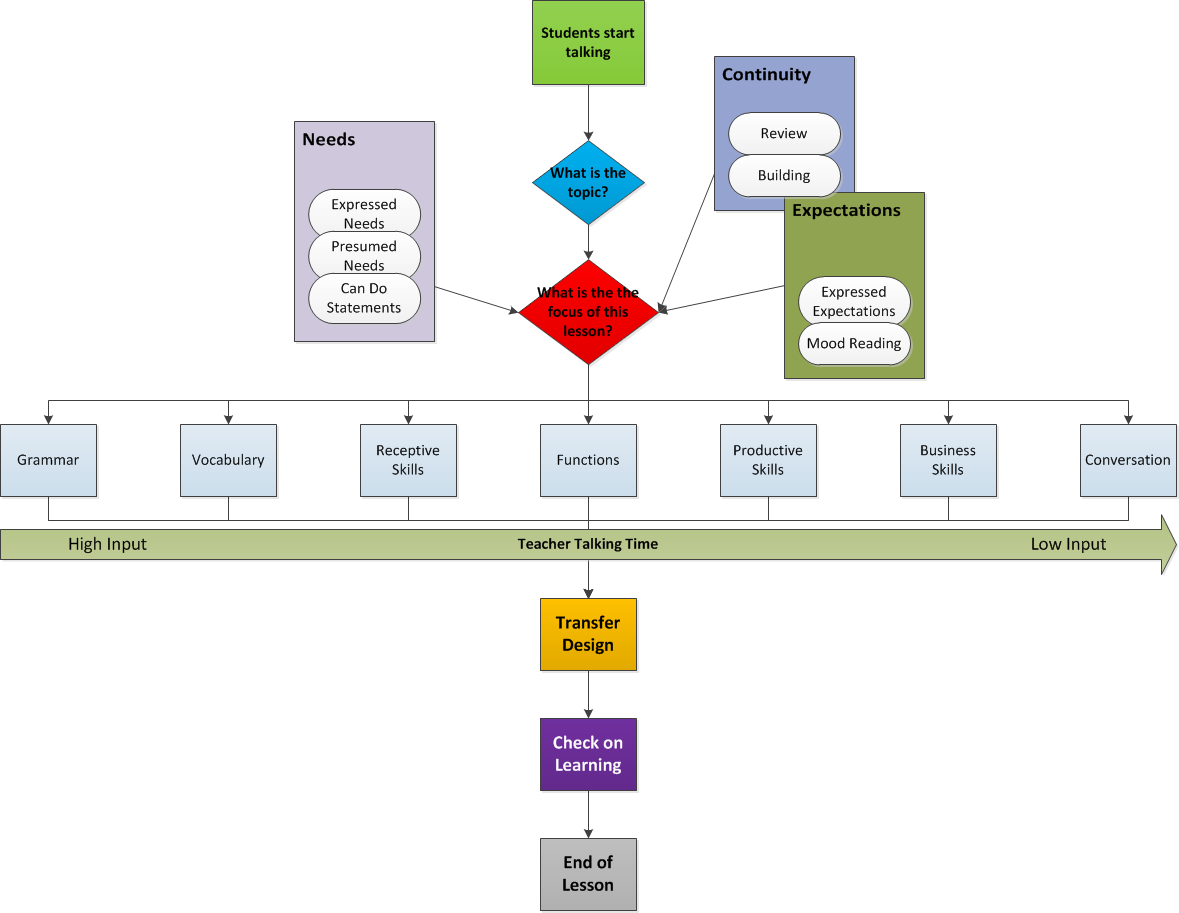
Click on the flow chart to enlarge.
Let me walk you through the steps.

Step 1 - The Students Start Talking

I don't use lots of scripted warm-up activities.  In most cases, my students have 60-90 minutes in class each week and they want to talk.  Sure, there are some confidence issues at first, but it doesn't normally take long for them to come in and start chatting.  Indeed, teacher input at the beginning or framework materials can direct the topic and in some cases, I have a specific pathway to follow.  Either I have announced (or we decided) the focus of the lesson beforehand, or I have certain needs which must be covered in a specific way.

If they do not start talking right out of blocks (or the class is consistently dominated by some) I may use targeted questioning to manage the discussion.  But mostly, I want the learners to talk about themselves and ask each other questions.  Usually it works easily, but I may need to provide structure (e.g. pair discussions) to assist.

Here are some simple examples of framework tasks or targeted questioning if the students don't start talking.

  • Draw a picture of your desk, workplace, apartment/house, etc.
  • What did you do yesterday evening when you got home from work?
  • Have you ever...?
  • What do you think about...?
  • I'm curious, why...?
  • Let's have a short update meeting, give us a one minute update on your current tasks/project.
Of course, the possibilities are endless.  In most cases, I consider this phase complete when the conversation moves from teacher driven to learner driven (either in topic or dynamic).

Step 2 - What is the topic?

At some point, I capture the topic and start to drive the conversation in a productive direction.  I have yet to find a topic which does not afford a variety of lessons.  Even something seemingly routine and mundane can be manipulated to achieve great results.  But some connections are clearer than others.  For example, sports leads quite easily into finance.  Depending on time, I will need to capture a topic quickly and work toward a focus.  Prescribed warmers, framework materials, and immediate input activities (like an article) will, of course, help drive a topic, but I prefer to let them express themselves freely.  I tend to remember that they have just left their desks and are looking forward to a few minutes of relaxation.  Constraints on the conversation may only cause negative feelings.  I am prepared to leave 15-30 minutes to finding a topic.

Step 3 - Determine the focus of the lesson

Once the topic has been captured, I will select a focus of the lesson.  This is not a lottery.  I have genuine expectations for the learners to improve and I have a duty to the customer to provide effective training to improve job performance.  I will quickly weigh three factors in determining the focus of the lesson.  Part one are the needs (and/or lacks, as Jeremy Day calls them), part two are the expectations for the training and lesson, part three is lesson continuity.  Depending on the situation, I will balance these factors.

For example, if it is an unusually stressful time in the company/department, it may be best to limit the demands of the lesson and take what you can get.  If the company goals trump what the learners expect then the training will have a different focus.  But note, this does not mean changing the topic, simply driving the lesson toward a tangible goal.  So, I have seven types of lessons which also determine teacher talking time and the quantity of input.  I prefer to continuously change the focus of the lesson and I feel uncomfortable (as do the students) when the class repeatedly follows the same pathway.

Step 4 - Focus on Language

Once I have selected the focus of the lesson, I have taken control of class.  In other words, 'We are going somewhere, and I'm going to take you there.'  The question is then, how are we going to get there?  What is the method?  The method often depends on my calculation of resources.

Here is a summary mind map of the resources I consider.
Click on the image to enlarge.
Part of this is a complete understanding of what resources are available.  As we remove each resource from the equation, we constrain our ability to design effective exercises.  If you have everything mentioned above, the activities are endless.

This is also where methodology comes into play.  For example, I may use a TTT, PPP, or guided discovery method to teach grammar.  I may focus on collocations for vocabulary.  Sometimes I even switch to the Silent Way mid-lesson.  In some cases, I may even get the idea that we should just keep chatting and have a mainly conversation class punctuated by occasional feedback interludes.  But this is not the default setting of the lesson and I'll often clarify this with the learners, "I get the feeling everyone is a little tired from work, is it alright if we just keep talking and I'll give you some feedback?"

From this methodology and resources balance, we'll have role plays or listen to a recording and dissect the language.  It all depends on the three factors.  This is why no lesson is the same.  Note:  I almost always ask the learners to design their own role play.

Example Lesson

A 90 minute lesson with tax consultants (B1-B2).  They had talked about the need to understand contracts in the previous lessons.  The learners have different offices, some work in the consultancy offices and some have offices embedded with a major client.  These students travel to the consultancy offices for the lesson.  One of them arrives in class with a giant stack of papers (possible resource!).

I am curious about the stack of papers and she tells me that it is training material in German (damn!) about recent tax law changes (topic?) and she has to learn it.  I ask if she feels 'out of the loop' (boarded) because she's away from management.  After a few minutes the conversation centers around the 'milk issue'.  When you work at the consultancy, coffee (plus milk and sugar are provided), but they have conflicts when using the milk and sugar at the client (coffee is negotiated and paid by the consultancy).  I recognize a prime a topic here (free coffee and the office kitchen are perfect for a variety of lessons).

I capture the topic and set a focus.  "That is interesting.  Okay, today in the lesson we are going to write a contract for the use of the kitchen and the 'milk issue'."  I have several resources.  First, the learners have probably read more contracts than I have.  I know register.  We have the internet so template/example contracts are searchable but printing is difficult.  I have a whiteboard with five markers.  Four are dry, so I have one color.  One learner has paper but no pen (I have an extra).  There are four students so pair work is possible without an obtrusive trainer.  I don't have a private space so while a negotiation might be nice, there is no real place for the two pairs to prepare.

I elect for a scaffolded approach to the productive skill (well, it is actually a receptive skills lesson through producing the language).  I say, "Okay, before we write the contracts, I'd like to give you a little support because contracts use a specific language."  I have 60 minutes left so I am looking at a limited scope, mainly focusing on word choice when changing register.

Input Segment

I point out the word shall.  Shall has different meanings between everyday British English (which the learners had in school) and contracts.  Shall = should + will in everyday English, but must in contracts.  A big difference.  I bring up a template contract (actually my rental agreement for my condo in Washington DC) to show how shall is used in contracts.  This reinforces the point.

Discussion Segment

I point out that shall is a signal word in contracts and I rely on their experience in contracts to find more (and to gauge their ability).  I am looking for words like guarantee, continuous, unobstructed, etc.  They offer a few, I offer praise.  We clarify, with the learners explaining meaning, and move on.

Eliciting Segment

My estimation of their language is that they are fairly proficient in socializing and that they struggle when they have to increase their professionalism.  On my list of needs is switching register and tone to speak to clients.  If you have read my blog before about need analysis, I create a table of needs instead of a linear pathway.

This topic and focus creates a great opportunity for addressing word choice to affect register.  I pull up an old PowerPoint presentation (actually, I disconnected the computer and pasted the table into the client's template) which had everyday informal words on one side and a blank column for formal words on the other.  For example, give = provide (this approach was inspired by the The Business coursebook from MacMillan).  I wrote down in my notebook that we should look at the Open University video on French influence later.  I also wrote the word 'Leo' because Leo Selivan has covered the various lexical layers of English in his talks.  The students are tasked with giving formal words with similar meanings.  The pair compare results and I add a few missed words (e.g. get = obtain, acquire).

Production Segment

Okay, I have 30 minutes left and it's time to get writing.  The students write the contract in pairs, I check it over their shoulder for accuracy, they read it aloud to the group.  I board key words like aforementioned.  We rephrase a few sentences by comparing and contrasting.

Done... its all about milk (which costs €.52/L but has an immense emotional value).

Step 5 - Transfer Design

I have become convinced that it is important to explicitly highlight how the lessons can be applied to the job.  During my talk at the BESIG conference Stuttgart on need analysis I said, "The learners don't know what they don't know."  I similarly believe that "The learners don't know how to use the lessons unless you tell them."  I like to end the lesson with a short reflective session on how the vocabulary, skill, etc. can be used in their job.  This is tantamount to commitment and I often record this in my notebook.  I may check up on this transfer in a later lesson.  In other words, this is part of the continuity factors when deciding the focus of the lesson.

Step 6 - Check on Learning

I like to have a review session at the end of the lesson.  In general, I expect that if I teach it once, they learn it.  Of course, this is completely unrealistic and I did not start out this way.  But I found that the students themselves felt guilty if they could not give the learning objectives of the previous lessons and said "Ach Scheiße!" if I corrected them on a mistake we had covered.  So, I expect the highest of standards.  If it is written on the board or sent via email in a PowerPoint... it should be learned.  I am understanding, but I don't let them off the hook or justify their non-performance.  If it is something I have covered repeatedly with one learner I will put them on the spot in front of the class.  Granted, it is wrapped in humor and rapport.

But the last phase is to check that they learned.  They will often say that they will apply the lesson (response bias) but fail the quiz at the end.  My most common method is to remove all supports (erase whiteboard, turn off projector, put away notes) and ask them to summarize the lesson.

Here are some example questions:

  • "Joachim, give me one word you learned today."  Then go around the class... it becomes progressively harder.  Periodically challenge other factors of understanding (register, spelling, etc.)
  • Use higher cognitive levels of understanding (Bloom's Taxonomy of verbs will help you devise questions).  "Sophie, what is the difference between Thanks for calling and I appreciate your call?"
  • "Okay class... I've erased the board.  Andreas, please come take the marker.  The class will help you recreate everything on the board."  

So, that's it.  That my lesson plan.  I wish I could tell you that I control what happens in every lesson, but I am simply a guide to the language.  I can only selectively direct each session to meet a specific need or expectation.  I would hesitate to say my approach is dogme because my default setting it attain maximum value, which I question about totally free-form teaching.  I still follow traditional teaching methods like task-based learning, but within the context of learner content.

I cannot give you lesson plans... I can only give you lesson reports.  They are quite different.  Sorry.


Rabu, 28 Agustus 2013

So, you want to teach Business English in Germany...?

Herzlich Willkommen!  You will find teaching in Business English in Germany exciting and rewarding, I'm sure.  But beware, its not all lessons in the Biergarten.  Here are ten things to help you work in Germany.

1.  German is a very hard language

There is a saying in German "Deutsche Sprache, schwere Sprache," which translates to "German language, difficult language."  Recently, football club Bayern Munich hired Pep Guardiola, the spanish legend, as their new coach.  He was hired roughly six months before he was to take on the position and was living in New York.  During that time he took German lessons to prepare for his new job.  He now gives interviews and leads press conferences in German.  In comparison, it took Franck Ribery nearly five years in the league to give his first interview in German.

Learning how to say, "We are just focusing on the next match." auf Deutsch

The commentary in the press routinely praises Pep for his amazing achievement.  His German is B2 level when he is fully prepared, A2 when answering spontaneously (my evaluation).  I have never heard criticism about Franck taking so long to adopt the language... after all it is very difficult.

In reality, it is not that difficult to learn.  To be sure, the gender pronouns cause considerable problems (der, die, das) and the problem is compounded because they affect adjectives.  Additionally, the Accusativ, Dativ, and Genetiv cases can be confusing, especially when dealing with prepositions.  In some cases, the resulting grammar makes no logical sense.  However, the German language has a set of fixed rules, which when learned, never change.  There are very few exceptions to the rules and with proper study (and some memorization) the levels become easier as you go along.

Of course, English is the exact opposite.  There is a lot grey area in English grammar.  This something that takes some getting used to.  My students are dumbfounded when I tell them, "Well, both are correct."  I often have to explain the difference between prescriptive and descriptive grammar.  Recently, the Süddeutsche Zeitung ran and article on English as Lingua Franca and said English grammar is "rudimentary". In short, Germans are often looking for rules when there are none and continually frustrated by exceptions (which abound).  They are surprised to find that we don't have a Duden, an official guide to correct German usage, upon which to evaluate correctness.

Some students will directly say that British English, in particular Oxford English, is correct.  This also includes received pronunciation.  While they have a point, focusing on this type of English may not have the most practical use.

So, in the end, I am not surprised at Pep Guardiola's achievement.  In fact, I would expect better from six months of classes (presumably one-to-one and intensive) with a crystal clear needs analysis.  German students, however, are often surprised at the difficulty of English as they improve.  It is a good idea to provide learners with 'guidelines' rather than 'rules' when necessary and use activities which teach a better feeling for the language rather than simply correct and incorrect.  When doing this, however, be prepared for resistance.

2.  Germans have two conflicting learning settings

If you start of a new class by outlining expectations for a course, you will probably be confronted with two very different methods of teaching.  The first is "learning by doing".  The students just want to talk.  They are often completely satisfied with a conversation class punctuated by some corrective and lexical feedback from the teacher.  The "bring in an article, read and discuss" lesson plan meets these expectations nicely and is even recommended by the students occassionally.

In the book "Der, die, was?  Ein Amerikaner im Sprachlabyrinth" the author David Bergmann humorously tells the story of learning German and it's idiosyncrasies.  In the book he mentions advice from Germans to "simply speak"... that is the best way to learn.  He compares this with learning a piano concerto by simply sitting down and starting to play.  Yet, many of your students will undoubtedly think that they can magically improve their language without any input or focused practice.


Along with this is the 'common knowledge' that you can only truly learn a language through immersion.  Occasionally, I counter this by presenting research which shows only mixed results for total immersion without a guide.  I also relate my own story about living in Germany for seven years without teaching.  My vocabulary was quite large but when I started lessons, I was still placed in the A1 group because I didn't understand even the most basic aspects of syntax and grammar.

As a result, one of the most important lesson to pass on to German students is 'noticing' the language around them.  Your students will certainly have a range of English exposure through news, television and signage (not to mention daily business).  Yet they rarely notice these words and I'm constantly surprised when they don't know an English word which is commonplace in German media.

The second learning method, which is less common, is the 'magic wand' learner.  These are the students who come to classes with the mistaken belief that somehow the teacher will transform them into English speakers through no effort of their own.  I believe this stems from their school experience in which English was often taught by lecture.  The teacher talks, the student listens, the student takes a written test to prove their knowledge.  This method has evolved in German schools now, but adult learners still carry this baggage.

This means that students might question (sometimes directly) the purpose of an exercise/class activity.  For example, guided discovery grammar teaching is unsuitable.  I've had students simply refuse to do the activity because they didn't see the point.  After all, the teacher's job is to teach, the pupils' job is to listen and learn.  So, sometimes it is best to clearly and directly state the pedagogical reason for a certain activity.  "This activity is designed to..."


So, you are likely to have classes in which the learning expectations are completely different.  One part of the class would prefer maximum speaking time and very little structured input.  The other part expects maximum teaching input and clearly structured practice activities.  Finding a middle can be a challenge and requires a certain bit of finesse.  Sometimes this means having clearly defined conversation and input driven lessons.  Sometimes this means teaching them about second language acquisition and methodology.  Sometimes this means changing people's minds about learning.

3.  German employees don't do homework

Clocking in and out at work is much more than an administrative task for German employees, it is symbolic ritual which signifies their distinct separation between work and personal lives.  Only the most dedicated students will do homework.  Typically you can use homework to distinguish goals.  Those who see English as a benefit for their personal happiness will do homework.  Those who see English only as a necessary tool for their work will not.

I wrote about this topic last year and I believe my previous post is still accurate, but the effects are limited.  Even with the most elaborately planned tasks and persuasion, I can still only get about 50% completion of homework.

This limits the trainer in many ways.  First, multi-session lessons are difficult to pull off.  Starting a topic in one lesson and continuing for weeks is a challenge.  Second, the flipped classroom is largely impossible.  Imagine assigning background reading for a lesson and then having one student complete it.  Third, more elaborate skills training is questionable.  I still typically assign presentation to my classes but I rarely have more than 75% actually create and deliver the presentations.  Fourth, vocabulary practice is almost zero.  If they need to increase vocabulary, it is best to limit the aims of the face-to-face lesson and hammer the words during the lesson.

4.  Verb tenses are a bitch (yup I used that word)

Judging by the coverage of verb tenses in international course books and websites, I'm sure that Germans are not alone.  But I have seen some interesting aspects of learning verb tenses among my learners.

First, they are obsessed with them.  For many grammar = verb tenses (called 'times' in German).  I can almost guarantee that you can walk into any German classroom, ask about their needs, and verb 'times' will come up.  Add in the grey areas I mentioned above and you have room for chaos.  Add in the 'magic wand' student to the mix and you have a recipe for disaster.

Second, their school teacher confused the hell out of them.  It is a useful exercise for a teacher in Germany to do a little tutoring for a while to get an idea of how they learn English in the schools.  English is now taught starting in the fifth grade (and sometimes vocab is taught earlier).  In the sixth grade it gets serious.  In the first three years of school English, the students are ask to master the Present Simple, Present Continuous, Past Simple (called the Simple Past in Germany), the Present Perfect, the Present Perfect Continuous, the Past Continuous, and the four future forms.  In year four, they are hit will the Past Perfect, Past Perfect Continuous and the future perfect forms.

A normal school year has 37 weeks with about 2 hours of English per week.  If we throw in testing (written and verbal), we are down to about 60 hours per year of class time.  Imagine trying to teach all 12 verb tenses (plus passives) in 240 hours.  Holy cow!  No wonder they are confused.  Adding to the issue is the fact that students often believe, for example, that the Past Perfect is just as important as the Past Simple.  After all, it was taught with the same emphasis in school.  I've even had students come to class proud to show me a table they made of all twelve verb tense forms plus passive.

So, here are some of my recommendations for teachers.  First, limit the number of tenses you cover in class but make sure they understand when to use them.  Second, expect interesting sentences.  The Present Perfect is, of course, the bugbear for Germans (the same form has a different meaning in their language).  But interestingly, they will be hesitant to use the Present Continuous while at the same time overusing the Past Continuous.  Third, spend considerable time on the future forms.  The prevalence of going to, will, and the present continuous for the future warrants a look.  Germans don't normally use a modal or verb form for the future so will be uncomfortable with it.  Finally, the difference in meaning is important enough to examine in class.  I have developed special ways of teaching these verb tenses to fit my learners... I encourage you to look at your methods.

5.  They are amazed that German and English are related

I don't know why but my student never seem to see how German and English are related.  There are so many words which are the same or nearly the same in the two languages.  Be prepared for questions like, "What mean organisieren in English?" or surprised faces when you say "Bratwurst is Bratwurst in English."  I guess Bier and beer doesn't quite do it.

I have also never met a German student who was not fascinated by loan words.  In fact, you can base an entire lesson on words like Schadenfreude, Kindergarten, and Zeitgeist.  I tend to think they few this patriotic revenge for all the English words they have adopted such as 'Shitstorm', 'Handy', 'Mobbing' and 'entertainment'.  The first three fit nicely into the loan word lesson because they have different meanings or usage.

But in essence, my students routinely fail to see the parallels between German and English.  This makes translation exercises particularly useful in the classroom.  For example, Germans are often confused by the second conditional because it uses the past tense.  First of all, I have decouple the form from time (handled in the verb tenses lessons) and then I can show them how it has a close cousin in German.  German has a rarely used, but widely known, subjunctive form which corresponds closely to the German preterite form (Past Simple).  Suddenly, when they see Old German matched with English they see the connection.  By the way, most schools do have lessons on Old German.

6.  There is only one register in German

Okay, this is not quite true, but register in German hinges on three things:  filler words, pronunciation and personal pronouns.  There are certain domain specific words like darüberhinaus (moreover) which are used in a super formal register, but for the most part Germans do not change words to change register.  For a German learner it is interesting to translate everyday spoken German to see register contradictions in English.  For example, "Dude, did you obtain the confirmation for your residency visa?"  or "Listen man, the requirements are totally confirmed."

One element of German is that distinct concepts have distinct vocabulary.  The same it true of English, but they are actually used in everyday German.  My four-year-old son routinely produce sentences with vocabulary which, when directly translated, would sound like a lawyer.  "I have consistently demanded that my brother stop hitting me!"

Register in German is primarily determined by eliminating regional dialect and speaking 'high German' (Hochdeutsch).  Primarily, this means removing regional filler words like fei, gell, echt, and na.  This also means reducing the dialect pronunciation.  Where I live, for example, /p/ and /b/ are pronounced the same (soft /p/), they same is true for /t/ and /d/ (soft /t/).  When they change register, they pronounce them correctly.

For the teacher, this poses a problem.  You will have to teach the students that the deciding factor for register in English is word choice.  I typically start by saying, "Okay, in German you change the pronoun 'you' (Sie and du).  In English, we change everything else in the sentence."  But most learners equate 'informal' English with 'unprofessional' English.  In some cases this is true, but in nearly all cases, the learners simply do not have the lexis to speak unprofessionally.  For example, I've never met a student who can produce the sentence, "Dude, I'm like totally stoked about this presentation!"

7.  Pronunciation is not a huge problem

When we think of German speakers we often attach the convenient Arnold Schwarzenegger accent.  But I find that phoneme pronunciation is not a major problem.  Sure, some work on the /th/ sounds is needed to keep them from sinking about sings.  And at the very beginner level water can sound like vater.  'Were' is often a beginner issue at well.  But for the most part, students sort these individual sounds out quite quickly.  In fact, I am often impressed at how my students handle the quintessential problem areas like 'through' and 'enough'.  Plus, long words can be tongue twisters.  Here is a list of words which nearly always cause problems.
  • clothes
  • debt
  • negotiate
  • unfortunately
  • graduate (both noun and verb)
  • photographer (my wife is one, so we find this often in my lessons)
  • apprenticeship
But for the most part, individual word pronunciation is quite good.

The main problem is sentence level pronunciation.  This is also, sadly, the area which teachers are least prepared to handle.  While the words are said correctly, be prepared for the 'German machine gun', bang-bang-bang-rat-tat-tat-tat.  You may even find that your students look at you questioningly when you go over short forms.  Expect revolt when you bring up wanna, gonna, and gotta.


Why?  Well, read number 6.  German register is typically defined by clear pronunciation.  Teaching them short forms is equivalent to teaching them 'bad English'.  Add in a few 'Oxford English is the right way' students and I hope you can find the explanation out of the mess you created.

Also, Germans are hesitant to show emotion through intonation.  They will use intonation frequently to avoid difficult question forms (for example... You live in Munich?) but will not be prepared to pause after adverbs of commentary.  But this general lack of emotion while speaking fits with the next point.

8.  Communication skills are mediocre to poor

Yup... I said it.  I'm sorry Germany... but your overall communication ability is below average.  You write poor emails, deliver boring presentations, and write indecipherable documents.  In most cases I trace this back to the education system and the German language.  As some of you may know, Germans do not receive a 'liberal education'.  They get a very basic background in humanities up to age 16 before they move on to subject specific practical skills.

University graduates are often the exception, but less than 20% of all high school graduates attend university.  In addition, you are not likely to find them in your classes because their English is typically at least business survival level, in most cases verhandlungssicher (able to discuss = proficient).

This means that the car mechanic is totally amazing at fixing cars but horrible at talking to customers.  Taking it a step further, the engineer (through technical school) knows everything about the technology but pisses all his international colleagues off with his emails.  Of course, I am making stereotypes just as others make them about pronunciation, but there is a certain amount to truth here.  As a teacher, you may have to point to the long-term benefits of relationship building at the expense of short-term clarity.


To be honest, this is difficult line to walk as a trainer.  Most certainly there are cases in which direct words are needed.  American and British communication trainers are often confronted by the opposite, conflict and directness is avoided at all costs, resulting in unclear expectations.  But there is a middle ground here, and the trainer in Germany should seek to find it.  When it comes to leading meetings and giving presentations, there are certainly tips which constitute best practice.  Most of your students will be unfamiliar with them, both in theory and in practice.

9.  They appreciate the outsider's point of view

Germans are crazy about feedback.  This includes everything from their language to their country to their culture.  However, I have noticed that they prefer for it to be delayed until they are finished speaking.  Interruption is generally taboo, both mid-sentence and mid-story.  For linguistic mistakes and gaps, it is generally best to record and highlight later.  Most of my students prefer seeing their language written and improved rather than hitting them mid-stream.  To be honest as learner, so do I.

The second thing is about differences in opinion.  Occasionally I have lessons in which one of the student takes the discussion off on an anti-American tangent (there are ample opportunities for this).  The NSA data security issue has been the latest in string of possible 'What the hell is America thinking?' subject.  Gun control was the topic of the spring.  The presidential election was last fall.  But no matter if it is political or simply about the best way to organize a to-do list, differences of opinion will appear in your lessons.

I have found that no matter how integrated I am in Germany (in fact that helps me build extraordinary trust), I am still the outsider in the room.  They count on me to bring in viewpoints from outside their world.  In fact, a simple way to change the dynamic of the classroom from me asking them questions is to get them to ask me about America, the world, and how we see Germany.  This particularly suits the 'learning by doing' expectations of learners and as long at the teacher watches the talking time, can make for a productive lesson.

For example, most Germans are surprised to learn that "Made in Germany" actually means what they think around the world.  They are surprised by the American fascination with the Autobahn and Mittelstand.  They rarely think about punctuality until it is in the context of another culture.  Likewise, they are truly confused by the concept of patriotism and how it affects worldview.

As I've mentioned in intercultural training posts before, it would be a good idea for the trainer to understand the underlying values of German culture before trying to discuss these issues.  Perhaps I'll blog about this in the future, but the key is to stop using utilitarian reasoning and check out some rights-based ethics.  Objectivity to key and truly appreciated.  No one appreciates criticism from an outsider, but an objective evaluation is interesting.  I find that Germans are intrigued by neutral analysis and have some kind of underlying desire to be evaluated.

10.  Germany is not a nation, it is collection of similar regions

Following the previous point, it helps a teacher in Germany to understand which region he/she is in.  Each holds its own traditions and culture which are preserved with pride.  I mentioned patriotism above, which will generally be foreign to most of your learners.  For them patriotism is generally about cheering for the German national team at the World Cup.  After the two months is over it is back to those "shit Bavarians".  Likewise, Bavarians think everything northwest of Frankfurt is the Ruhr area, an industrial wasteland of welfare recipients and broken down societal systems.

There are many reasons why stereotypes and rivalries exist in Germany, some going back centuries.  It may be too much to ask for a trainer to dive into history and ethnography to try to understand them.  But the artifacts of this are clearly visible and provide ample opportunity to fruitful lessons and discussions.

First is dialect.  Picking on dialect is one of the prime sources of humor in Germany and they can talk about the differences at length.

Second is food.  In Bavaria, food translates to sausage.  In fact, I could hold entire lessons on the differences between bratwursts.  I certainly don't look down on this.  I am from Kansas City and I could describe all the minute differences in barbecue across the US and advocate clearly why KC has the best.

The third is football.  The football team you cheer for says a lot about your personality.  Enough said.  Also, I have never met so many women season ticket holders.

Finally, we have values and beliefs.  If you are new to Germany, let me give a short beliefs overview.  The south is Catholic and conservative.  The west is Protestant and liberal.  The east is less religious (although  Protestant) and focused on whichever method can fix the problems they have (population loss, unemployment, immigration, extreme nationalism).  Certain cities have special attitudes.  Munich is the city of snobs.  Berlin is poor but sexy.  There is growing tension in the media between international gentrification and true Berliners.  Cologne (Köln in German) and Hamburg are the most open cities.  Dortmund, Duisberg and other cities in the Ruhr area are the blue collar hubs of Germany.  Stuttgart makes cars (Porsche and Mercedes) and money (large Mittelstand).  The Turks are in all the main cities, each claiming to have the largest group.  It is best to stay away from this issue as far as you can, especially as you may have second generation Turkish in your class.

One of my hangouts in Berlin during my CELTA, the Irish pub around the corner was my planning HQ.

So, for me this means that I have to balance conflicting beliefs in my classes.  The majority of my learners are Franconian (a part of Bavaria, but distinctly proud of their regional identity... dare I say nation).  About a quarter are immigrants from within Germany, mostly from the former East Germany.  And a small percentage are from other countries who have moved to Germany for opportunity.  But regional culture makes for interesting and engaging lessons.  People like talking about their identity and it provides great contexts for role plays.

So, watch out for these things I'm sure you'll have as much teaching in Germany as I do!

Bis dann...


Rabu, 14 Agustus 2013

Widening the Feedback Channel

Let's talk about feedback.  Without question, Business English Trainers are dedicated to feedback.  We understand it as a valuable part of the communication process.  We attempt to instill it in our learners by giving then useful phrases for obtaining/giving feedback as well as the benefits.  In many cases, our lessons are largely feedback driven.  We observe the language and interject to provide linguistic input for clarity, style, and meaning.  Giving effective feedback is one of the crucial elements of being an English Teacher.

Sometimes we distill this skill to 'error correction', but any trainer can tell you that feedback is much more than simply 'mistake hunting'.  I see that I have not blogged about the '4 Levels of Listening'; perhaps I can do it soon.  In the meantime, you can look at a professional development workshop I ran last year which mentions the topic.


Surprisingly, what I see is that trainers are quick to preach feedback and reluctant to take it.  This is understandable.  Easy to say, harder to do.  Negative feedback hurts.  After all, we have worked for hours to do our best only to find out that our effort was wasted.  What an insult!

But I follow the words, "Feedback is a gift."  As I move forward with a few long-term projects, widening the feedback channel is vital for helping me design and refine engaging and productive lessons.  I have learned to crave negative feedback and integrate it every step of the way.  Honestly, positive feedback is less important to me because I walk into most lessons thinking that the agenda is truly engaging, helpful, and worthwhile.

Here are a few methods for obtaining valuable feedback.

Feedback Trading

At the end of a lesson, say that you will give feedback on their performance if they give you the same.  Typically this is written and often involves a structure.  For example:

I will give you three focus areas for you to work on in English communication.  You give me three things I should do as a trainer to meet your expectations.

This takes about 15 minutes and with larger classes some preparation may be needed.

Flip chart - keep/change

Draw a t-line on the flip chart.  On the left side write "keep" and on the right "change".  Ask the learners to tell you what elements of the training we should keep and what elements we should change.

For example, in my recent classes I have found that they want to keep the variety of the lessons and the feedback-based instruction.  However, they would like to read more articles and play Taboo.  No problem... I introduced more reading/internet searching into the class and we play Taboo for 30 minutes once a month (I bought the real UK version on Amazon).  Attendance is higher than before.

Meet one-to-one

To be honest, this is most difficult method of feedback.  First, learners do not like to tell the trainer bad things.  Maybe they do not have the learning experience to even make a comment.  Second, it lacks the anonymity of written feedback.  Third, they are unaware of their peers' expectations of the course and hesitant to impose their demands on the group.

However, when handled properly, individual meetings can provide key insights into what is going right and wrong with a course.  These are particularly valuable after an extensive time with the group (when they know the group dynamics).  The key for the trainer is implementation with confidentiality.  In other words, when you change something, make it look like a pedagogical idea.

-  Learner desires a traditional and structured approach to learning
-  Trainer: "I know we don't normally do gap-fills, but research show that they are useful for remembering vocabulary.  Here is a gap-fill I created, you have five minutes to complete it."

Important:  When you receive negative feedback, do not attempt to justify your actions... just take it.  Stand there, nod your head, and take it.  It hurts sometimes.  You can direct the conversation to another person, "Jim, what do you think?" but you should not answer.  Write it down and think about it.

Colleague status

This is clearly limited to certain courses and special environments.  But this is the goal of every group I teach whether in one department or from diverse groups.  I want to build trust to the point that we can talk openly about every element of the training (and the business).  The colleague status is developed by combining the three in-class methods mentioned above plus regular communication, dedication, and common goals.

The hardest part of my job is convincing them that my satisfaction comes from watching them succeed (in fact, the most student I lose are those without goals).  I truly believe that if your inspiration is entirely self-serving, then you will never be able to deliver the service needed to maximize value added.  But this convincing takes time.  It is not an approach they are used to.

This means regular engagement with the learners to find out their problems, help them through them within the business constraints, provide accurate input at the time of need, etc.  In essence, value comes from being an integral part of their work life.  Running off copies and preaching about the Present Perfect Continuous does not normally do it.

Once feedback is constant in both directions, you will find the the glass doors to the person/business open wide and lead to immense value added.

Conclusion

While I have discussed three feedback techniques, the final element of colleague status is truly the pinnacle of excellent training and customer service.  The first step is that we seek, accept, and finally crave feedback from our learners in the same way they desire it from us.  It can change the entire dynamic of a class or project and considerably impact contract renewal and wages.

Senin, 13 Mei 2013

Giving Learners Control of Skills Training

As I am sure everyone is aware, there are two types of grammar:  prescriptive and descriptive.  Prescriptive is a set of rules which standardize grammar and determine whether something is right or wrong.  Descriptive is a study of language as it actually is used to deduce a set of grammatical commonalities.

It looks like most teachers agree that teaching the descriptive grammar is more useful for the learners as communication trumps some arbitrary form of correctness.  Why, then, are we teaching prescriptive skills?

Prescriptive Skills

There is no one right way to lead a meeting, give a presentation, engage in a negotiation, write an email of request, and so on.  Research on discourse and the field of pragmatics help show something we already know... we change our language as we perceive the situation.  This goes way beyond register and whether something is formal or not.

Some have argued that language teaching should be more contextualized to ensure pragmatics are included and students gain the skills needed to alter their language to fit discourse.  This makes perfect sense.  But sometimes I see materials which have "Key Phrases for Meetings" or how to write a formal complaint.  This, however, adds a certain set of prescriptive rules for communication which may not always be appropriate.

A classic example of this are dialog structuring activities which allocate select phrases to students A and B to be used in a 'language flowchart'.  The context is provided through detailed role-plays and case studies.  But often I feel that these violate my "Train as you Fight" motto I picked up in the military.  In other words, the training context should be as close to real-world conditions as possible - modified only for ability.  This same approach is echoed repeatedly in other training fields when they discuss transfer design.

"Take this three times a day to cure bad meetings."
Descriptive Skills

So, if the intent of skills training is to introduce as much realism as possible, it is best that it includes contextual concerns.  This includes culture and relationship of the interlocutors, the communication conventions (e.g. structure, templates, etc.), intent, and desired perception.  When we add all of these together, it is clear that there is no one best way.

The problem is the complexity of all this.  How are we supposed to find resources for all of this information? How can we possibly create a list of phrases for meetings in every context?  This would be simply unworkable.  No doubt we as a profession have tried.  One day, I would like to compile all the useful phrases for small talk in my library and see how we are doing.


Hard to describe but it looks like art to me.
The answer is two-fold.  One, we have to accept complexity.  We have to understand that by describing something we inherently limit it.  By describing an effective presentation, we make all the other methods wrong.  So what happens if one week we do presentation training and the next week we watch a TED talk?

The second part of the answer is accept that we don't know everything.  The key to skills training is the students themselves. They can quickly offer all the contextual information we need and tell us what success looks like.

Elicited Rubrics

A key element of performance-based training is the assessment rubric.  I have written a bit about performance assessment in two earlier posts (lessons from the military and assessing quality).  Judith Mader has done extensive work on performance-based assessment in the field of pre-experience learners.  She's even written a book about it.  At the heart is designing a list of criteria and then evaluating whether the student met each of those criteria during the task.

For example, a very simple performance rubric might look something like this:

Note:  This is prescriptive...
So, my goal in skills training to develop a rubric which will not only assess the training event, but also give the learners a series of steps to successful fulfill the task.  It also provides ample room for teacher and peer feedback.  These rubrics can be extend to the right to include grading scales and exact performance measures.

Here is an example from a university for a written paper:


So, how do we create rubrics without assuming too much about context?  The answer is sitting right in front of us.  They know the interlocutors.  They know the context.  They know what they like and don't.  Let's ask  them.  By having an introductory conversation about the skill in context we can define the performance criteria together.  Furthermore, they have a stake in the process and are more likely to provide constructive feedback and transfer the skill to the workplace.

Lesson Idea 1 - Email to Request Information

With this B1-B2 class I had already conducted a needs analysis based on the communicative event, so I knew that requesting information from fairly distant colleagues was a common task.  The lesson was only 60 minutes so I needed to keep the frame fairly small.

I started the lesson with 10 minutes of small talk and catching up.  Then we came to the point.

Today we are going to write an email to request information.  You have just received an Outlook invitation for a meeting in Munich on May 29th (Munich is about 2 hours away).  You recognize the name of the organizer, but you don't know him.  We are going to write an email to find out more about the meeting and if we should accept.  I haven't included more information because I want you to fill in the details.

Then I created a mindmap on the board with "Request for information" in the middle.  Above it I wrote "Preferred" and below I wrote "To avoid".  We started by discussing things that should be included in the email (preferred).  We then added items which should be avoided.  As the moderator of the discussion, I made sure is encompassed linguistic as well as topical issues.

Then, they wrote the emails and I wrote one as well.  I ran to the copy machine and make copies for everyone.  While they were reading I marked the emails for corrections.  We then compiled phrases used by the various students to be used later.

This simple mindmap exercise can be done with any communicative event.  What makes a good meeting chairperson?  What should they avoid?  What is good when describing a presentation graphic?  What should we not do?  The teacher can help break it down to sentence level if needed.  But it is important that they provide the contextual information.

Lesson Idea 2 - Presentation Rubric

Above you have seen a prescriptive rubric for a presentation introduction.  I have also made such charts with the class.  Below is a lesson example from a tax consultancy.

Today we are going to practice starting a presentation.  You have been asked by the company to give a presentation to your client about new regulations on value-added taxes in Germany.  You will have to inform them about the changes so that you can file the VAT returns quickly and correctly.  Today we will practice only the introduction of the presentation... what you will say at the start.  So, let's start by talking about what is important to have in this introduction.

After the conversation, the rubric looked like this.


So, as a trainer, I knew what to listen for.  In this case, I actually put this rubric on the projector (I had a flipchart to brainstorm and projector to record) so that the small groups could give peer feedback.

Conclusion

At the end of both of these lessons, I left ample time for feedback and a chance to discuss what had happened during the training.  These rubrics can also be used for review or building to a larger task.

Prescribing a most effective way is not always bad.  Indeed, I use it often for certain groups.  For pre-experience learners there is little alternative.  For wide ranging need sets, it is sometimes acceptable.  And I will also use it for remote training (e.g. eLearning and email coaching) where feedback is not possible.  But this type of training is the lowest common denominator.  It should be better.

The point is, if we profess to know the best way to perform a business skills, we place our learners at a disadvantage.  Just like a prescriptive grammar teacher creates students who cannot operate in the real world, we can do the same with skills.  We need to accept the complexity of our learners' world, acknowledge that neither we nor our resources know everything, and let our students define the context.  Using the communicative event analysis provides us the tool for developing the framework materials, but it is up to the learners to take that step further to outline the rubric.  Naturally, the trainer is contributing every step of the way, but leading by questions... not by prescription.


Rabu, 22 Agustus 2012

The High-Low Dilemma: Recommendation for Presenting Culture

Assumed knowledge:
  • The difference between high and low context cultures
  • How this difference can impact communication
Issue:

The difference between high and low context is a theoretical concept that is difficult to translate into activities for training.  The trainer can either present the theory and use examples to illustrate the difference, or they can show 'model' communication to mitigate the risk of misunderstanding.  Furthermore, because high and low context is not exclusive to national culture, the learners must be able to identify different communication styles in various situations.  This effectively eliminates the value of trainer generated models because they may not be appropriate to the situation.  Therefore, it would be best to give the learners a more solid understanding of how cultural context affects communication and let them apply the lesson to their needs.

Discussion:

There are many points of view on the topic, but I will highlight just two.  Going back to 2010, Evan Frendo offered an outstanding menu of comparing and contrasting activities.  They were all based on input from the trainer on the theory.  The learners are then ask to apply, analyze, synthesize, and evaluate the differences.  The weakness in the approach is in the presentation phase.  I feel that presenting Edward Hall's theory as an academic topic is not a guarantee for comprehension.

Another approach is that from authors Bovèe and Thill from Business Communication Essentials (Pearson, 2012), a fairly standard university text book.  The book echoes a wide range of business communication material when it states, "The different expectations of low- and high-context cultures can create friction and misunderstanding when people try to communicate across cultural boundaries."  While certainly sound, this doesn't give the trainer or participant much to work with.  The authors then provide a model of effective intercultural communication with some basic tips.  Sadly, the model consists of a sterilized business letter.  While extremely clear it does little to support Bob Dignan's ideas of building relationships, influencing people, or building trust.  Effective for the immediate event, it does little for the long-term business relationship.

Recommendation:

So, to compliment Frendo's activities, a better method of presentation is needed.  From this, the learners can create their own trainer supported models to fit their communication needs.  One method is to link lesson plans we are already using to illustrate the difference between high and low cultures.  After all, the employees are already living in a high-context company culture.  Also, they all remember starting at the company and trying to understand 'the way things are done'.

1.  The Unwritten Rules of the Company

A good model for this lesson can be found in Vicki Hollet's series Lifestyle (Intermediate by Iwonna Dubicka and Margaret O’Keeffe).  This will help define the company culture.  In the lesson, the learners discuss and formulate the unwritten rules of the company. Language point - modals of obligation

2.  Your First Day

Learners tell stories about the challenges they faced during their first day/month at work.  Language point - past tenses and past obligation

Some guiding questions can help the lesson:
  • What company/school did you come from?  How was it different?
  • Did anyone help you understand the unwritten rules?
  • Did you come in and give lots of recommendations or sit back and listen?  Why?
  • Do you remember any mistakes you made?  How did your colleagues handle them?
  • What were the most important lessons you learned?  How did you learn them?
  • Did you understand what everyone was talking about (terms, projects, people, etc.)?
  • What did you think about your new colleagues?  How did they treat you?
  • Did you ever hear...
    • That won't work here.
    • We don't do it that way.
    • Trust me, this is the best.
    • We already tried that xx years ago.
3.  The New Hire's First Day

From here the lesson moves to giving advice for an employee's first day.  Using the previous lessons, the learners must 'sponsor' a new employee.  This could be done as a role-play, a written list supported by instruction, etc.  The new hires should prepare a list of questions for their sponsors to help make the transition faster.  Language point - giving advice, modal question forms

4.  Reveal the Learning Point

It is at this point that the trainer reveals that their company is a high-context culture.  It has its own traditions, conventions, symbols, etc., everything that makes a culture.  The trainer can also show the difference between the way they talk to each other in class (high-context) and the way they explain things to the trainer (low-context).  Because the difference is already illustrated using a personal situation, it is much clearer for them to understand.  One visual way to reveal this is to board the advice under the title "Company", then replace with "China". 

5.  Replace Company with Culture

Now that the learners comprehend the difference, it will be much more fruitful for them to do activities like Evan Frendo's or create models for their communicative situations.  Now they can better analyze their communication.  Furthermore, the tips they gave to the new hires and the questions they wrote for the sponsor are great resources.  They will mirror the advice given by Dignan, Bovèe, Thrill, and others.  The questions are very useful when working with their foreign contacts when they need help navigating the confusion.

Question for the reader:
This post uses a specific communication style.  Did it feel strange to read such a blog post?

Selasa, 07 Agustus 2012

Why Grammar is Still Important

The chorus among my colleagues seems to be reaching a nice harmonious tone about grammar.  All the voices seem to say that it's no longer important.  It's all about communication they say, and has simply no place in the Business English course... well, okay with lower levels, sure we need it.  And if it causes a misunderstanding, certainly.

I started listening to this siren song some time ago and began to all but remove grammar from my lesson plans.  I gave some feedback, but gone was the 90 minute lesson on getting all our 'if's and 'would's in the right place.  But over time, I feel the pull of grammar bringing me back and while I'm still not running entire lessons focused on a certain element, grammar is tangible in nearly every lesson.  So, I thought I would spell out a few reasons why it's still okay to teach grammar (even to higher levels) and why we can even learn to love it again.

1.  Grammar is image

We have been watching Cars a lot in my house lately.  Cars and Cars 2 are films from Disney/Pixar about a race car, Lightning McQueen, and his best friend, Tow Mater, a lovable redneck tow truck.  In the second movie they introduce Finn McMissile, a soave British secret agent.

Michael Caine and Larry the Cable Guy. 
Photo of Michael Caine: Harry Wad, both from wikipedia.org

Here's a quiz based on these two pictures:
  1. Which man is the voice of the lovable redneck tow truck?
  2. Which man is the voice of the soave British secret agent?
  3. Who uses the sentence... "My apologies, I haven't properly introduced myself."
  4. Who uses the sentence, "Ah!  I knowed you wasn't gonna leave without sayin' goodbye!"
  5. Which image would your learners most like to portray?
My point is that grammar is somewhat like a set of clothes.  Do we want to send our learners into a meeting dressed like Larry the Cable Guy?  This type of appearance probably isn't going to help them persuade others or defend their ideas.  Sure, other NNSs may give them allowances, but having good grammar shows qualities useful in business, namely persistence, hard work, mastery, and attention to detail. 

2.  Without grammar it's not language teaching

The basic truth is that our learners expect teaching in grammar.  It is one of the core aspects they expect in our classes.  Sure they may not want to spend a lot of time listening to the teacher drone on about when to use the past perfect, but grammar is one of the ways they measure their own progress.  Unlike vocabulary, which they may or may not see again in their daily lives, they will recognize grammar.  It also helps the learners battle ambiguity.  Especially in writing, they have fewer doubts, "Is this right or not?"  That is a big confidence boost.

In fact, grammar serves as the key to unlock meaning.  We often ask our learners to try to define unknown words in context.  We ask them to find collocations and lexical chunks.  Without understanding the grammar, they cannot perform these tasks.  For more difficult texts, it can be very difficult for them to even distinguish the core sentence from the accompanying clauses.  Giving them a set of keys to unlock meaning will give them more freedom to understand outside the class room.  Without it, they are limited to the set phrases and functional sentences we give them.  If they aren't used, the learners will struggle.


3.  Grammar is relatively easy to teach

Let's be honest, we can't walk into every classroom every week and be 100% engaged.  Setting up and evaluating skills training can be hard work.  Listening for lexical gaps and absent functional phrases takes immense concentration.  Sometimes we are tired, distracted, or just plain having a rough day.  Identifying and filling grammar deficiencies is much easier to do.  We should certainly try to do more when monitoring, but it's not always possible.

Grammar provides a great way for the teacher to relax a little bit.  We all have a bank of grammar based activities and ideas to draw upon at a moment's notice.  We all have our standard way of teaching the present perfect continuous and passive modals.  Sometimes it does us good to dust those off and have a nice standard grammar lesson.  The learners will get something and the teacher can live to fight another day.

4.  Grammar teaching supports awareness of language

By dissecting the language, the learners are practicing the skill of analyzing what they say and how they say it.  This supports our other training areas.  It shows them that small things can make a huge difference.  It then becomes easier to show them how word choice can change the tone of a sentence.  We can then show them why formal language is different than informal language.  It better enables us to show how discourse markers help the listener to understand.  Etc., etc.

My approach

I continue to listen politely to my colleagues about grammar.  And I will give them one concession,  we need to prioritize which grammatical elements to include.  There are many steps between Finn McMissile and Tow Mater.  We need to think about which elements will help them fit the image they want to portray.

I now include a grammar element in nearly every lesson I have.  Sometimes it is planned based on the text/listening, sometimes it is feedback driven, but it is always there.  It worries me when dismissing grammar in Business English training becomes so common that we take it for granted.  In meetings with other trainers it seems as though we compete at who teaches it the least.  This is not the right approach and is not helping our learners.  But I suspect many of them are secretly teaching it anyway :)

So, learn to embrace it and love it... just don't let it get too passionate.

Senin, 23 Juli 2012

Lessons learned from the military to BE

Back from vacation and ready to work :)

As some of you may know, I was in the US Army before I was an English trainer.  As a Sapper (combat engineer) my life was consumed by the neverending cycle of training-execution-training.  During my seven years in the military and three years in combat, I rose to the position of platoon sergeant, including designing several company training programs in insurgent tactics and dealing with improvised explosive devices.  I was passionate about training and adopted the military's models and processes whole-heartedly.

Your author doing a little training... note, I had to swim back, too.

However, after my CELTA and beginning in the BE field, I seemed to forget much of what I had learned and practiced during my previous career.  It wasn't until about a year ago that I sat down and took stock of my military experience and how it applied to my new passion.  In the end, I distilled five points which apply to in-company training.

1.  The Mission Essential Task List (METL)

A METL is a list of key tasks a unit must be able to successfully accomplish in order to fulfill their mission.  For example, when I entered the Army in 2002, we were still trained in the 1980-90s conventional warfare skills.  In that situation, a combat engineer platoon must be able to emplace a standard NATO minefield.  This essential task supported the company's METL to emplace a battional defense.  Below platoon, a squad had a list of essential supporting tasks for the minefield.  Below that, each individual soldier had to master a list of key tasks (such as arm a mine) for the whole unit to be successful.

As an English trainer, this shows us two things.  First, our learners do not exist in communication isolation.  They belong to teams, departments, and business units.  The individual skills we teach them are part of a larger goal.  It is helpful for us to consider how we are supporting these goals.  Second, the key skills needed by the learners are mostly determined by their position within the structure.  In English training, the most generic METL is the ALTE can do statements.  These are particularly valuable for pre-experienced learners just as the individual soldier task list drives the basic training program in the Army.  However, once we are in-company, a key part of pertinent training is defining the essential skills for the learners, their teams, and their departments.

2.  Task, Condition, Standard (TCS)

To evaulate performance, every task needed is outlined using the task, condition, standard format.  Basically, the task is restating what the learner should be able to do.  The condition outlines the environment in which they are expected to perform the task.  And finally the standard is a 'checklist' of performance steps for them to correctly execute.

For example, here are the standards for throwing a hand grenade:
FM 3-23.30 Grenades and Pyrotechnic Signals, Dept. of the Army, approved for public release 

Back to English teaching, this sounds like something we should be doing with our skills training.  Yet measuring can do statements in this way is not universal.  Oxford University Press and John Hughes have taken a step in this direction with their skills assessment criteria in the Teacher Book from Business Result.  However, I would like to see more of this in 'opening a meeting', 'making arrangements on the telephone', etc.  For myself, I have set the task of writing out some of these performance steps and the conditions under which they must be performed (e.g. in a conference room with projector and presentation).  Perhaps we need to borrow something from our academic colleagues on this one... they are the experts at assessment.


Writing a letter home in 2003 near Hit, Iraq

3.  Crawl-Walk-Run

Once each needed skill is defined in the METL and the TCSs are set, the military trains to proficiency using the crawl, walk, run approach.  Under this approach, the task and the standards are kept the same, but the conditions are changed.  This means increasing speed, spontaneity, complexity, and realism.

From FM 7-1 Battle Focused Training, Dept. of the Army, approved for public release

Note, the performance steps remain the same, only the situation becomes more difficult.  For example, in a presentation setting, this could mean that questions from the audience become more difficult, speakers could have non-native accents, etc.

In general, I try to incorporate this into my training.  So, when the learners become confident that they can participate in a meeting, I start adding more challenging elements.  For example, I will add in listening with Asian accents, add the element of interruptions and unclear vocabulary, place the meeting under pressure constraints such as time or consensus, reduce/remove prep time, add an additional skill like note taking, etc.  This helps build the difficulty.

4.  Train as you fight, fight as you train

This all adds up to the next lesson.  In the military the goal (especially in the run phase) is to make the training as realistic as possible.  In the Army this means using live ammunition, throwing in surprises, and generally making the situation as confusing as possible.

I believe once our learners in the BE classroom have mastered the basics in the supportive environment of the classroom, it is time to make the training reflect the real world.  In group classes, here is where the participants themselves really add to the course.  They can ask the tough questions and play the role of difficult people.  They can give the pointed criticism needed to make the situation more realistic.  As Claire Hart pointed out on her blog, getting the learners out of the class on the factory floor adds needed realism.

In short, we need to prepare them for the battlefield.


5.  The After Action Review (AAR)

The final lesson distilled was the importance of the After Action Review.  Basically, this was a post training meeting to take stock of our performance and formally acknowledges strengths, areas for improvement, and lessons learned.  In the military, we had formal drawn out AARs with written summaries but perhaps more effective were the 5 minutes 'hot wash' AARs.  In these short meetings we sat down as a team and discussed the training event with the following agenda.
  • Review the training objective
  • What was supposed to happen?
  • Relavent training resources we used
  • What happened?  Why?
    • What did we do well?
    • What do we need better?
    • What lessons did we learn?
  • Make a plan to improve shortcomings and build upon strengths
Overall, AARs were direct and candid, but never personal.  I am still amazed at how the participants were able to criticism.  But the key factor here was that everyone had the same goal... make the team better.

In an in-company training environment we need to use AAR like breaks to critically assess our performance.  In some courses, this can be done after every lesson.  But not all of our participants are going to have such thick skins.  As trainers, our job is to effectively observe their performance and offer feedback without hurting any feelings or damaging reputations.  This is certainly not easy, but the AAR was the key link between our current skills and future improvement.

Conclusion

I am certainly not advocating that we systematically formalize all of our training and execute it lock-step as we did in the military.  Much is to be said for the holistic approach, and such formalized training does not always align with the learners' expectations and desires.  Additionally, implementing these methods requires a significant amount of planning and admin time which can eat away at choosing and designing the best activities.  However, I feel that as professional in-company trainers, such an approach toward training helps us to ensure that the time spent in class is actually making a positive impact on their job performance.

Selasa, 10 April 2012

The Trainer's Learner Autonomy Scorecard; Assessing our Ability to Foster Transformative Learning

As an addition to my post on the BESIG World Blog, I would like to share some more ideas on fostering learner autonomy in the Business English classroom.  The purpose of this post is give trainers a self-assessment tool for how well they are encouraging learner self-reliance.


At the core of this issue is the question whether it is our duty to develop our participants into autonomous learners.  On one hand, participants can certainly reach their training needs and remain 100% percent dependant on the trainer.  However, I would argue that by helping develop learner autonomy we can achieve greater results in a shorter period of time.  I would also argue that it increases the value of our training because the participant is better able to adapt to new needs after the training is completed.  Personally, watching a class grow into inquisitive, independent learners is the most rewarding part of my job.


This process, however, is not easy.  It takes a considerable amount of time, energy, and patience on the part of both learner and trainer.  Either party may not be willing to accept this responsibility.  We must consider this fact in terms of what our clients want and expect as well as what kind of commitment we are willing to make i.e. time and fees.


My research into learner autonomy has led me to the characteristics of adult learners and the concept of transformative learning.  For a short introduction transformative learning, I recommend this site from the University of Geogria.  My research also led me to a research article by Kathleen Cercone for the State of Connecticut titled Characteristics of Adult Learners with Implications for Online Learning Design.  What makes this article special is how clearly it outlines the various characteristics of adult learners.  These include:
  • Have responsibilities which hinder the learning process.
  • Want to be actively-involved in the learning process
  • Have a pre-existing learning history and will experience a paradigm shift
  • Have prior experience and need to connect new with old
  • Adults are problem-centric
  • Want to know what they are going to learn, how it will be conducted, and why it is important
  • Need to 'test' their learning
  • Require dialog, interaction, and self-reflection
Based on these characteristics, Cercone outlines a long list of objectives for trainers to encourage learner autonomy and enable transformation.  The primary focus of her article was the online learning environment.  But I found her concise tips equally suited to face-to-face language teaching.


Therefore, I have adpated her ideas and incorporated comments on my own to develop an Adult Learner Autonomy Report Card.  The purpose of the report card is to self-assess where you are in your teaching and give tips for improving the self-reliance of your learners.  A short word of warning, it may take about an hour to complete the evaluation.  Several concepts or repeated in the assessment (e.g. needs analysis, self-reflection, building a supportive group, etc.), but I have left them to highlight their importance at various levels.  I hope you find the report card helpful and worth the effort.  Simply the act of writing it has helped me guide my training in the future.