Tampilkan postingan dengan label learner content. Tampilkan semua postingan

Rabu, 14 Agustus 2013

Widening the Feedback Channel

Let's talk about feedback.  Without question, Business English Trainers are dedicated to feedback.  We understand it as a valuable part of the communication process.  We attempt to instill it in our learners by giving then useful phrases for obtaining/giving feedback as well as the benefits.  In many cases, our lessons are largely feedback driven.  We observe the language and interject to provide linguistic input for clarity, style, and meaning.  Giving effective feedback is one of the crucial elements of being an English Teacher.

Sometimes we distill this skill to 'error correction', but any trainer can tell you that feedback is much more than simply 'mistake hunting'.  I see that I have not blogged about the '4 Levels of Listening'; perhaps I can do it soon.  In the meantime, you can look at a professional development workshop I ran last year which mentions the topic.


Surprisingly, what I see is that trainers are quick to preach feedback and reluctant to take it.  This is understandable.  Easy to say, harder to do.  Negative feedback hurts.  After all, we have worked for hours to do our best only to find out that our effort was wasted.  What an insult!

But I follow the words, "Feedback is a gift."  As I move forward with a few long-term projects, widening the feedback channel is vital for helping me design and refine engaging and productive lessons.  I have learned to crave negative feedback and integrate it every step of the way.  Honestly, positive feedback is less important to me because I walk into most lessons thinking that the agenda is truly engaging, helpful, and worthwhile.

Here are a few methods for obtaining valuable feedback.

Feedback Trading

At the end of a lesson, say that you will give feedback on their performance if they give you the same.  Typically this is written and often involves a structure.  For example:

I will give you three focus areas for you to work on in English communication.  You give me three things I should do as a trainer to meet your expectations.

This takes about 15 minutes and with larger classes some preparation may be needed.

Flip chart - keep/change

Draw a t-line on the flip chart.  On the left side write "keep" and on the right "change".  Ask the learners to tell you what elements of the training we should keep and what elements we should change.

For example, in my recent classes I have found that they want to keep the variety of the lessons and the feedback-based instruction.  However, they would like to read more articles and play Taboo.  No problem... I introduced more reading/internet searching into the class and we play Taboo for 30 minutes once a month (I bought the real UK version on Amazon).  Attendance is higher than before.

Meet one-to-one

To be honest, this is most difficult method of feedback.  First, learners do not like to tell the trainer bad things.  Maybe they do not have the learning experience to even make a comment.  Second, it lacks the anonymity of written feedback.  Third, they are unaware of their peers' expectations of the course and hesitant to impose their demands on the group.

However, when handled properly, individual meetings can provide key insights into what is going right and wrong with a course.  These are particularly valuable after an extensive time with the group (when they know the group dynamics).  The key for the trainer is implementation with confidentiality.  In other words, when you change something, make it look like a pedagogical idea.

-  Learner desires a traditional and structured approach to learning
-  Trainer: "I know we don't normally do gap-fills, but research show that they are useful for remembering vocabulary.  Here is a gap-fill I created, you have five minutes to complete it."

Important:  When you receive negative feedback, do not attempt to justify your actions... just take it.  Stand there, nod your head, and take it.  It hurts sometimes.  You can direct the conversation to another person, "Jim, what do you think?" but you should not answer.  Write it down and think about it.

Colleague status

This is clearly limited to certain courses and special environments.  But this is the goal of every group I teach whether in one department or from diverse groups.  I want to build trust to the point that we can talk openly about every element of the training (and the business).  The colleague status is developed by combining the three in-class methods mentioned above plus regular communication, dedication, and common goals.

The hardest part of my job is convincing them that my satisfaction comes from watching them succeed (in fact, the most student I lose are those without goals).  I truly believe that if your inspiration is entirely self-serving, then you will never be able to deliver the service needed to maximize value added.  But this convincing takes time.  It is not an approach they are used to.

This means regular engagement with the learners to find out their problems, help them through them within the business constraints, provide accurate input at the time of need, etc.  In essence, value comes from being an integral part of their work life.  Running off copies and preaching about the Present Perfect Continuous does not normally do it.

Once feedback is constant in both directions, you will find the the glass doors to the person/business open wide and lead to immense value added.

Conclusion

While I have discussed three feedback techniques, the final element of colleague status is truly the pinnacle of excellent training and customer service.  The first step is that we seek, accept, and finally crave feedback from our learners in the same way they desire it from us.  It can change the entire dynamic of a class or project and considerably impact contract renewal and wages.

Senin, 13 Mei 2013

Giving Learners Control of Skills Training

As I am sure everyone is aware, there are two types of grammar:  prescriptive and descriptive.  Prescriptive is a set of rules which standardize grammar and determine whether something is right or wrong.  Descriptive is a study of language as it actually is used to deduce a set of grammatical commonalities.

It looks like most teachers agree that teaching the descriptive grammar is more useful for the learners as communication trumps some arbitrary form of correctness.  Why, then, are we teaching prescriptive skills?

Prescriptive Skills

There is no one right way to lead a meeting, give a presentation, engage in a negotiation, write an email of request, and so on.  Research on discourse and the field of pragmatics help show something we already know... we change our language as we perceive the situation.  This goes way beyond register and whether something is formal or not.

Some have argued that language teaching should be more contextualized to ensure pragmatics are included and students gain the skills needed to alter their language to fit discourse.  This makes perfect sense.  But sometimes I see materials which have "Key Phrases for Meetings" or how to write a formal complaint.  This, however, adds a certain set of prescriptive rules for communication which may not always be appropriate.

A classic example of this are dialog structuring activities which allocate select phrases to students A and B to be used in a 'language flowchart'.  The context is provided through detailed role-plays and case studies.  But often I feel that these violate my "Train as you Fight" motto I picked up in the military.  In other words, the training context should be as close to real-world conditions as possible - modified only for ability.  This same approach is echoed repeatedly in other training fields when they discuss transfer design.

"Take this three times a day to cure bad meetings."
Descriptive Skills

So, if the intent of skills training is to introduce as much realism as possible, it is best that it includes contextual concerns.  This includes culture and relationship of the interlocutors, the communication conventions (e.g. structure, templates, etc.), intent, and desired perception.  When we add all of these together, it is clear that there is no one best way.

The problem is the complexity of all this.  How are we supposed to find resources for all of this information? How can we possibly create a list of phrases for meetings in every context?  This would be simply unworkable.  No doubt we as a profession have tried.  One day, I would like to compile all the useful phrases for small talk in my library and see how we are doing.


Hard to describe but it looks like art to me.
The answer is two-fold.  One, we have to accept complexity.  We have to understand that by describing something we inherently limit it.  By describing an effective presentation, we make all the other methods wrong.  So what happens if one week we do presentation training and the next week we watch a TED talk?

The second part of the answer is accept that we don't know everything.  The key to skills training is the students themselves. They can quickly offer all the contextual information we need and tell us what success looks like.

Elicited Rubrics

A key element of performance-based training is the assessment rubric.  I have written a bit about performance assessment in two earlier posts (lessons from the military and assessing quality).  Judith Mader has done extensive work on performance-based assessment in the field of pre-experience learners.  She's even written a book about it.  At the heart is designing a list of criteria and then evaluating whether the student met each of those criteria during the task.

For example, a very simple performance rubric might look something like this:

Note:  This is prescriptive...
So, my goal in skills training to develop a rubric which will not only assess the training event, but also give the learners a series of steps to successful fulfill the task.  It also provides ample room for teacher and peer feedback.  These rubrics can be extend to the right to include grading scales and exact performance measures.

Here is an example from a university for a written paper:


So, how do we create rubrics without assuming too much about context?  The answer is sitting right in front of us.  They know the interlocutors.  They know the context.  They know what they like and don't.  Let's ask  them.  By having an introductory conversation about the skill in context we can define the performance criteria together.  Furthermore, they have a stake in the process and are more likely to provide constructive feedback and transfer the skill to the workplace.

Lesson Idea 1 - Email to Request Information

With this B1-B2 class I had already conducted a needs analysis based on the communicative event, so I knew that requesting information from fairly distant colleagues was a common task.  The lesson was only 60 minutes so I needed to keep the frame fairly small.

I started the lesson with 10 minutes of small talk and catching up.  Then we came to the point.

Today we are going to write an email to request information.  You have just received an Outlook invitation for a meeting in Munich on May 29th (Munich is about 2 hours away).  You recognize the name of the organizer, but you don't know him.  We are going to write an email to find out more about the meeting and if we should accept.  I haven't included more information because I want you to fill in the details.

Then I created a mindmap on the board with "Request for information" in the middle.  Above it I wrote "Preferred" and below I wrote "To avoid".  We started by discussing things that should be included in the email (preferred).  We then added items which should be avoided.  As the moderator of the discussion, I made sure is encompassed linguistic as well as topical issues.

Then, they wrote the emails and I wrote one as well.  I ran to the copy machine and make copies for everyone.  While they were reading I marked the emails for corrections.  We then compiled phrases used by the various students to be used later.

This simple mindmap exercise can be done with any communicative event.  What makes a good meeting chairperson?  What should they avoid?  What is good when describing a presentation graphic?  What should we not do?  The teacher can help break it down to sentence level if needed.  But it is important that they provide the contextual information.

Lesson Idea 2 - Presentation Rubric

Above you have seen a prescriptive rubric for a presentation introduction.  I have also made such charts with the class.  Below is a lesson example from a tax consultancy.

Today we are going to practice starting a presentation.  You have been asked by the company to give a presentation to your client about new regulations on value-added taxes in Germany.  You will have to inform them about the changes so that you can file the VAT returns quickly and correctly.  Today we will practice only the introduction of the presentation... what you will say at the start.  So, let's start by talking about what is important to have in this introduction.

After the conversation, the rubric looked like this.


So, as a trainer, I knew what to listen for.  In this case, I actually put this rubric on the projector (I had a flipchart to brainstorm and projector to record) so that the small groups could give peer feedback.

Conclusion

At the end of both of these lessons, I left ample time for feedback and a chance to discuss what had happened during the training.  These rubrics can also be used for review or building to a larger task.

Prescribing a most effective way is not always bad.  Indeed, I use it often for certain groups.  For pre-experience learners there is little alternative.  For wide ranging need sets, it is sometimes acceptable.  And I will also use it for remote training (e.g. eLearning and email coaching) where feedback is not possible.  But this type of training is the lowest common denominator.  It should be better.

The point is, if we profess to know the best way to perform a business skills, we place our learners at a disadvantage.  Just like a prescriptive grammar teacher creates students who cannot operate in the real world, we can do the same with skills.  We need to accept the complexity of our learners' world, acknowledge that neither we nor our resources know everything, and let our students define the context.  Using the communicative event analysis provides us the tool for developing the framework materials, but it is up to the learners to take that step further to outline the rubric.  Naturally, the trainer is contributing every step of the way, but leading by questions... not by prescription.


Jumat, 23 November 2012

Two Easy Peer Feedback Methods

Peer feedback can be extremely valuable in the BE classroom, especially when it comes to communication skills.  There are two reasons for this.

First, my learners are typically all in the same company and/or department and have a better grasp of the conventions within the discourse community.  Second, the learners have years of experience and training in various areas which they can draw upon to give feedback.  For example, several of my learners include project managers who have taken part in many training sessions on relationship building and giving feedback.  It is great to spread that knowledge.

Of course there are many other great reasons for constructive peer feedback, but there are also dangers, too.  Without direction and some limits, peer feedback can be overly positive or only highlight shortcomings.

For example, here is some peer feedback I received on a proposal I wrote for a university class.


·         Your introduction is very wordy.  I would consider consolidating some of the paragraphs and cut back on so many words.  Once you write the Letter of Transmittal you will realize most of what you wrote in your introduction will also be in your Letter of Transmittal.  Your introduction should be concise and to the point. You use too much detail for the reader in the first two paragraphs, which led to repeating most in the body of your proposal.  
·         Your title page doesn’t include who you ultimately want to read your proposal.  In our textbook on page 289 the title page lists who it is prepared by and who it is prepared for.  The prepared for individual will also be the name you address your Letter of Transmittal to. 
·         I would also consider spelling out what R&D because readers may not understand the acronym. 
·         You are also missing table of contents, which is a requirement for the report.
·         When using visuals you should name them in the proposal i.e. Figure 1, Figure 2, etc. Also if you pulled your illustrations from somewhere else you need to cite those as well. 

Hardly motivating... did I do anything well?  By the way... I did fine on the final assignment.

A Simple 3-2-1

I like to use a simple 3-2-1 feedback format for peer feedback.  I simply write on the board prior to a presentation, meeting, email, etc.

Write:
3 things they did well.
2 things they can improve.
1 thing you want to take and use in your presentations, emails, etc.

Then after the simulation/role play, I give them time to fully write out their feedback for the person.  I do not read them and let the learner look at them without pressure after the lesson.  Typically, the learner will come back the next week and thank their classmates for the excellent responses.  Then when we are giving class presentations, all participants are more likely to give complete, honest, and constructive feedback because they will receive the same in return.

Email Workshops

A second method for extensive peer feedback is email workshops.  I will set up pair groups and give each pair the task to write an email.  Each situation will be similar.  Note:  I will change the emails based on the target function.

For example: (the learners are told to fill in details to fit their job/situation)


Group A
  • To introduce yourself to a new business contact.  You will be working together in the future.
Group B
  • To follow up on a conference.  You met the person for the first time and talked shortly, exchanged cards and agreed to stay in touch.
Group C
  • To get in touch with a former friend / colleague.  You were close before but lost touch after several years.  But now you may need some help from him / her.
Then, the pairs compare and contrast their emails based on subject line, greeting, opening, structure, opening for discussion/response, closing, formality, and length.

Then I will have someone run to the copy machine and make copies for everyone.  Note: I give them an email template on A4 paper with all the top fields and a writing area.

Then the members of the three different groups will read the other emails.  While they are reading, I will mark the emails for accuracy and vocabulary.

To conclude, the members of the groups will meet together and discuss dos and don'ts in there situations, good structure, appropriate phrases, etc.  We will bring all the information together on a powerpoint slide and that will go out to the participants.

The participants absolutely love it.

So, two ideas on how I use peer feedback in my classrooms.

Rabu, 25 Juli 2012

Review lesson and tax lesson using authentic materials

The two lessons I taught this morning... both received high praise.

Context

The client is an international tax consultancy.  The lessons are held on-site and the minimalistic luxurious conference room is equipped with a large flatscreen intended for videoconferencing, but accomodates my computer hook up as well.  There are two groups, 90 min once a week.  The first group is lower level (A2-B1) of mostly clerks who conduct more straightforward tax declartions for international clients and then a higher group (B1-B2) which consists mostly of advisors who guide their clients through international tax regulation.  The lesson today for the first group was to review what we had learned.  The follow lesson to the higher group was based on the Germany-US Double Taxation Agreement.

Lesson One - Review

I had just returned from vacation so we when through my selection of photos and discussed what makes a good beach.


Then we began the real lesson...
  • I gave them an envelope filled with the vocabulary words we had seen over the past few lessons.  I keep a running excel list of vocab which I send to them post lesson.  The spreadsheet is open during the lesson and instead of a whiteboard I fill the columns.  To create the cards, I simply paste to word, change the size of the cells, print, and cut out.
  • Then, I asked them to choose 4 colors from a selection of color cards I collected from the hardware store.
  • Next, I asked them to group the words by color.  In order to do this, the learners had to understand the word and explain to their group why it should fit with the color.  In the process they were explaining the meanings of the unknown words.  I stepped in for troublesome words they were avoiding and asked for the pronunciation of other (like exaggerate).  But the rationale was their own.  For example, one group put 'to order' with the caramel color because he envisioned ordering dessert.  Because their office phones have a green button to make a call, both groups placed all the telephone words with green.  The next time we do telephoning, I will probably print the exercises on green paper.  Words from the email lesson tended to be in blue.... hmmm.
  • They then changed groups and had to explain to others how they had grouped the words.  I filled in gaps and answered questions.  By the end, I was confident that we had reviewed and could use most of the words, especially the business specific lexis.
  • We then moved onto a jeopardy game to assess our learning.  I used a free jeopardy game for this and two teams.  It was effective and students like it.  I recommend the site.  Note:  You will have to download the application and the game text file to make sure it works on your computer.  I did not use the online version because I am never 100% certain about connection and I don't like the ads.

    You can find the online game version of the game we played here.
  • To conclude the lesson we reviewed our course plan and expectations and discussed what was working, what they had used in their jobs, and what could be improved.


Lesson Two - Double Taxation Agreements

The second lesson began as the first, with my vacation pictures... but they wanted to chat a bit more comparing Italy and Croatia.  No problem... let them play with the English a bit.

Then the lesson began...
  • Warmer - what is a Double Taxation Agreement (DTA) and why do we need them?
    Here are the discussion questions... this allowed those with more experience to clarify what we are talking about (actually all the participants work with regulations like this).

    Why do taxation agreements exist?
    What flaws are in these agreements?  Give examples.
    Are there any loopholes which can be exploited?  Give examples.
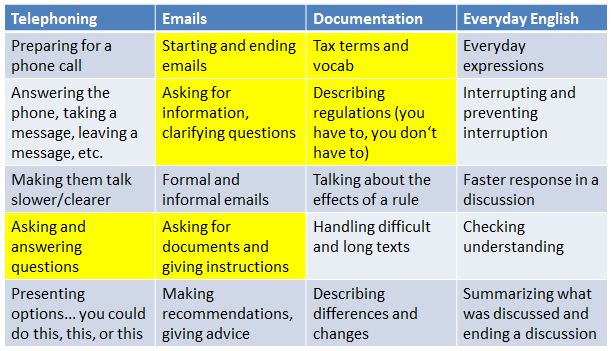
  • Next, I gave them a word cloud from the US-Germany DTA.  The document was available from the IRS website in the US.  I cut and pasted it into wordle and printed to pdf.  I handed out copies of the cloud.  The task was like Taboo.  They had to describe words and their partner had to say which word from the cloud they meant.  This was a risky deep-ending activity and I wasn't sure, but their command of lexis in this discourse community was quite good.  I only jumped in to challenge them a bit and make sure some of the key words were covered.  By the end of the activity their minds were ready for the text.

  • They did not receive the whole text, only the cases included in the treaty (starting page 7).
    Germany US DTA
  • Luckily for me the US-Germany DTA included specific examples for how to apply the treaty.  When I use contracts and formal legal documents in the future, I will search for these examples.  One example reads...
          Facts:
A third-country resident establishes a German company for the purpose of acquiring a large U.S. manufacturing company. The sole business activity of the German company (other than holding the stock of the U.S. company) is the operation of a small retailing outlet which sells products manufactured by the U.S. company. Is the German company entitled to treaty benefits under paragraph 1(c) with respect to dividends it receives from the U.S. manufacturer?

The task was to read the case and check understanding with a partner.

  • Next, the learners were to describe their situation to their 'tax advisor' and find out if they could use the DTA and why.  The 'tax advisors' were given the answers from the DTA.  For example the answer to the case above reads...

          Analysis:

The dividends would not be entitled to benefits. Although there is, arguably, a business connection between the U.S. and the German businesses, the "substantiality" test described in the preceding examples is not met.


  • They were having trouble with this task and understanding was not 100% so I gave them a follow-up task.   Explain the case using graphic representation.  Show the investors, subsidiaries, dividend flow, etc.  This produced the outcome I was looking for.  They were better able to explain the situation and why the DTA did or did not apply in this case.  One woman stated during the lesson, "These are exactly like the cases we deal with on a daily basis.  Where did you get these examples?"
  • The surrounding discussion was amazing.  The learners were activating vocabulary.  I was able to make corrections on functional language.  We had reached flow.  In addition, they were linking all this to their previous knowledge and questioning if the US-Germany DTA was really so.  They were learning more than just English.

So... two great lessons this morning.  One a simple review lesson, the second shows the benefits of a good communicative event analysis ("I have to explain the impacts of double taxation") and tapping the discourse community.

    Selasa, 10 April 2012

    The Trainer's Learner Autonomy Scorecard; Assessing our Ability to Foster Transformative Learning

    As an addition to my post on the BESIG World Blog, I would like to share some more ideas on fostering learner autonomy in the Business English classroom.  The purpose of this post is give trainers a self-assessment tool for how well they are encouraging learner self-reliance.


    At the core of this issue is the question whether it is our duty to develop our participants into autonomous learners.  On one hand, participants can certainly reach their training needs and remain 100% percent dependant on the trainer.  However, I would argue that by helping develop learner autonomy we can achieve greater results in a shorter period of time.  I would also argue that it increases the value of our training because the participant is better able to adapt to new needs after the training is completed.  Personally, watching a class grow into inquisitive, independent learners is the most rewarding part of my job.


    This process, however, is not easy.  It takes a considerable amount of time, energy, and patience on the part of both learner and trainer.  Either party may not be willing to accept this responsibility.  We must consider this fact in terms of what our clients want and expect as well as what kind of commitment we are willing to make i.e. time and fees.


    My research into learner autonomy has led me to the characteristics of adult learners and the concept of transformative learning.  For a short introduction transformative learning, I recommend this site from the University of Geogria.  My research also led me to a research article by Kathleen Cercone for the State of Connecticut titled Characteristics of Adult Learners with Implications for Online Learning Design.  What makes this article special is how clearly it outlines the various characteristics of adult learners.  These include:
    • Have responsibilities which hinder the learning process.
    • Want to be actively-involved in the learning process
    • Have a pre-existing learning history and will experience a paradigm shift
    • Have prior experience and need to connect new with old
    • Adults are problem-centric
    • Want to know what they are going to learn, how it will be conducted, and why it is important
    • Need to 'test' their learning
    • Require dialog, interaction, and self-reflection
    Based on these characteristics, Cercone outlines a long list of objectives for trainers to encourage learner autonomy and enable transformation.  The primary focus of her article was the online learning environment.  But I found her concise tips equally suited to face-to-face language teaching.


    Therefore, I have adpated her ideas and incorporated comments on my own to develop an Adult Learner Autonomy Report Card.  The purpose of the report card is to self-assess where you are in your teaching and give tips for improving the self-reliance of your learners.  A short word of warning, it may take about an hour to complete the evaluation.  Several concepts or repeated in the assessment (e.g. needs analysis, self-reflection, building a supportive group, etc.), but I have left them to highlight their importance at various levels.  I hope you find the report card helpful and worth the effort.  Simply the act of writing it has helped me guide my training in the future.

    Jumat, 02 Maret 2012

    10 Tips for ESL Presentation Coaching

    For me, one of the most rewarding experiences as a trainer is to rehearse actual presentations and web meetings with participants.  For them, it is a huge confidence boost and helps them stay on message during the real thing.  For us, we gain valuable insight on the business, and are better able to provide targeted follow-up training.

    This situation, however, requires trainers to change roles and expectations for the training event.  When setting up the training there are several keys to success.  First, try to have the training in the same environment as the real event.  If it is online, set up a web meeting.  If it is in a technical training room, reserve the training facility.  Second, try to get the presentation before the event to help you prepare.  For the most part the rehearsal will be participant led, but walking in with some warning of what you are about to see it helpful.  Third, make sure the participant brings a printed copy of the slides to the training.  Constantly changing between presentation view and edit view in PowerPoint disturbs the flow of the rehearsal.  It is better to make written notes on the slides for later reference.  This also allows the participant to review what we covered after the training.  Finally, try to enlist the help of a colleague to sit in and also give feedback and take notes.  This person will help refine the content of the presentation and can augment trainer feedback.

    Once the training is arranged there are several tips for a successful coaching, here are ten.

    1.  Audience Analysis

    More than likely, the presenter has been so wrapped up in the details of the presentation that they have forgotten about the audience.  First, elict as much information about the audience as you can.  Who are the attendees?  What are their jobs?  What do they expect to get from the presentation?  Second, because most presentations are given to other non-native speakers, try to find out what level of English we are talking about.  Very often I see slides come back from the translators at a higher level.  We need to make sure the audience will understand what we are presenting.

    2.  Modelling

    It is helpful to give the participant a starting point by modelling the introduction or certain key parts of the presentation.  This could include key diagrams and graphics or particularly complex topics.  Remember to keep the model at the level of the participant.  So, if the presenter is B1 and the audience is assumed to be A2, keep the language appropriate.  Setting the bar too high is demotivating for the presenter.  We are hoping to avoid the phrase, "Oh wow!  You should give this presentation."

    Modelling also provides the opportunity for the trainer to highlight discourse markers like "First..", "Next...", and "Let's take a look at..." as well as topic and slide transition phrases.  The model is only to get the ball rolling and should be as short as needed (typically 1-2 minutes is enough).

    3.  The slides as an aid / hindrance

    The slides can both help and hinder the presenter.  The presenter will naturally want to use the text from the slides as much as possible to help them find the words.  This causes several problems.  First, it normally distorts their body language and reduces the impact of their voice.  Second, if the attendees are not clear about the meaning of a bullet point, explaining it in the same terms will not help their understanding.  Finally, overusing the text often disturbs the flow of the explanation.  The presenter explains bullet point one... stops... reads... then explains bullet point two.  This makes it difficult for the listener to get the context of the slide and how all the parts fit together.

    On the other hand, slides can provide a great reference for the presenter to organize their thoughts and signal where discourse markers should be placed.  I advise my learners not to have written notes or slide presentation notes because they already have most of the information on the slides.  Instead, we should look how we can use the text to aid the presentation.  I recommend placing some key words in bold, italics, or in different colors so that when they look at the screen they can quickly identify the main points before speaking.  Often, I will also have the learner turn away from the screen or close their eyes and simply talk about what they know on the subject.  This helps give the slide more flow and explains the text in different words.

    4.  Timing

    In most cases, the English presentation is copied or adapted from a presentation in L1.  The learners often fail to realize that presenting in L2 will take much longer.  Sometimes to fit the presentation into the allotted time slot, difficult choices must be made.  For example, if the most important information is at the end of the presentation, you might want to consider reorganizing the slides.  We don't want to be rushing to finish during our main point.  I find that the same number of slides and amount of content will take at least 50% more time than in L1 (depending on level).

    This is also a time to remind them that going faster is not really the best answer.  Because the audience is also non-native speaker, they will need more time to to read the text, listen to the presenter, and understand the material.

    5.  Audience Multitasking

    Expanding on this, it helps to shows the presenter what the audience will be doing during the presentation.  In L1, it is possible for the audience to read, listen, and think about the material simultaneously.  In L2, this is a huge challenge.  Often, the presenter will change slides and dive right in talking about the material.  I typically tell the learner not to be afraid of silence.  Give the audience a moment to digest the material.  Don't ask them to read and listen at the same time... they will stop doing one or both.

    6.  Two-way Communication

    Many business presentations are inherently one-way communication, but in the L2 environment two-way communication is crucial for the presenter.  The audience will be very hesitant to interrupt them with questions and if they don't understand the material they might be too embarrassed to acknowledge it.  I encourage the learners to state at the beginning that if the audience doesn't understand something, let the presenter know.  The presenter will also often try to avoid two-way communication to minimize the demands in English.  They present a slide, transition, and start talking about the next.  Encourage the participant to stop, ask for questions, watch for non-verbal communication, ask for feedback, etc.

    7.  Realistic Changes

    Most of these training events occur shortly before the real presentation.  It would be great to be part of the drafting process, but that is not always practical.  So when making suggestions for changes we need to be realistic about how much time the learner has.  A rule of thumb is that for small edits, estimate 5 minutes per slide.  For text reorganization, 10-15 minutes per slide.  For larger reorganization and changes, 20-30 minutes per slide.  We don't want to make recommendations and then either stress the learner to make them (giving them less time to consider our feedback) or cause them to doubt the quality of the presentation.

    8.  Content Gaps

    One helpful thing during the rehearsal is to listen for topics they are not covering.  Have they assumed some kind of prior knowledge because they are an expert?  This is where having the colleague in the room can be very helpful.  When I am reading the presentation before the training, I am thinking of what questions the audience will have for the presenter.  Sometimes we find topics that the participant has simply forgotten to include in the presentation.

    9.  Limited Language Input

    This is not really the time for language input and correction.  Vocabulary retention is minimal in this context and improving accuracy should not be the aim of the training.  That said, any glaring cultural errors or errors which could cause significant misunderstandings should be corrected.  Occasionally, I will monitor for accuracy, but mostly only to drive future training.  In this scenario, we need to give the learner as much confidence as possible, pointing out verbs tenses doesn't help this effort.  I will, however, listen for words or phrases which are overly used, such as "overview" or "in this environment" and try to help the learner find other expressions.

    10. Review and Summarize

    Finally, save some time at the end of the training to review what you have covered, distill the feedback into general concepts, and make task lists prior to the presentation.  The coaching event is a stressful time for the learner and they have probably not had the chance to take everything in.  Also, they have been 'on stage' and have not had the opportunity to stop, take some notes, and really consider the feedback.  This review and summary stage helps them implement the advice they have received.

    Of course, after the training event, check back with the learner to find out how everything went and congratulate them for a job well done.  The students will be thankful for your feedback and truly grateful for helping them make a great impression on their audience.

    Selasa, 31 Januari 2012

    Great Ideas for Using Phones in the Classroom

    Great post from Nicky Hockly on mobile phones in class.

    http://www.emoderationskills.com/?p=736&cpage=1#comment-23139

    I'm keeping my eyes open for using the camera in a BE context.  Company policy could be an issue, it would be best to check first what students should and shouldn't take pictures of.

    Idea 1:  "My Workplace"

    Students take pictures of their office, desk, kitchen, canteen, even colleagues.  They then share the photos in small groups.  It would be great practice for "giving a tour".  Target language... "This is my colleague Jim, he's responsible for..."  "Here is the conference room, we'll have our meeting in here." etc.

    Idea 2:  "My Commute"

    Similar to the "My Workplace" lesson it would start good conversations about the trip to work (often a small talk topic).  Additional English awareness exercize could be to take pictures of all the times they see/hear English on the way to work.  It could be on the radio (picture of the radio would be funny and be great use for reported speech).  It could be advertisements.

    Idea 3:  "The Conference Room"

    Students take a picture of the conference room in which they have meeting in English.  The explain where everyone sits, why they are in the meeting, and what they contribute.  The describe in detail their last meeting in this conference room and we are slowly building roles (and moving chairs).  As a group we then either reenact the meeting or simulate the next meeting.

    Hmm... tomorrow I will look for more.