Selasa, 05 Februari 2013

Consumer or Producer: Which Are You?


Focus first on finding where YOU can add value as opposed to where value can be added to you and watch how you're blessed from it!  We had a good conversation about this on my Live BIG Die Empty Facebook page recently.  The common wisdom these days is all about what people can do for you...


What a horrible testimony!  Listen to my Google+ Hangout with Don Purdum this week as we talk about consuming vs. producing and what this has to do with healthy relationships and successful business.


I really think you'll enjoy this talk.  Let me know what you think.


Mark Anthony McCray helps people live on PURPOSE, achieve higher PERFORMANCE and experience true PROSPERITY. Be sure to subscribe to this blog so you don't miss a thing and forward this to a friend if you found it helpful. All material © Copyright, Mark Anthony McCray unless otherwise noted!

He can be reached in the following ways:

Mark@LiveBIGDieEmpty.com
Phone: 281-846-5720
Twitter: @LiveBIGDieEmpty
Facebook: http://www.facebook.com/LiveBIGDieEmpty
LinkedIn: http://www.linkedin.com/in/markanthonymccray/
Google+: https://plus.google.com/u/0/103149858138414160703/posts
YouTube: http://www.youtube.com/user/markanthonymccray
Pinterest: http://pinterest.com/markmccray/

For more information on Mark as a speaker or presenter check out http://livebigdieempty.blogspot.com/p/about-mark_29.html

10 Ways to Live BIGGER!


If the past year wasn't everything you expected, don't live in regret. If 2013 hasn't start the way you wanted, DO SOMETHING ABOUT IT!! Get the tools you need to dream bigger dreams, set higher goals and accomplish them! Learn to plan, take action and GET UNSTUCK!

When: Thursday, February 21 @ 8:00 PM Central Time

Sign Up Here Now ☛ http://forms.aweber.com/form/99/20517699.htm

You don't want to miss this! It only takes one right idea and the right time to change your future. Here's the way I see it: You can learn from my mistakes or you can make your own. Learning from some of mine is free and painless. Learning from your own hurts a helluva lot and costs a lot, too!

After participating in this call, you will understand...

* The basic components you need to understand in order to set and achieve meaningful goals.
* Steps you can take to create instant momentum in your life.
* How to let go of past failures, regrets, guilt and shame.

I will even go over my recommended reading list. My sincere hope is that 2013 will be a season of shifting for you as you begin to grab hold of everything God has for you!

Also, if you want to work with me privately, please e-mail me at mark@livebigdieempty.com. I can take on a few more people. This is serious now and it's time to be diligent. When I work with you one-on-one, we get specific about action items and accountability so that you get clarity and change!

Sign Up Here Now for the call and I'll see you there! ☛ http://forms.aweber.com/form/99/20517699.htm

This is a FREE coaching call. It will be well worth your time. If you like it and want more, check out The Live BIG! Die Empty. Purpose & Empowerment Webinar© on Tuesday, March 5, 2013 from 6:00 PM to 8:00 PM (CST)!


Mark Anthony McCray helps people live on PURPOSE, achieve higher PERFORMANCE and experience true PROSPERITY. Be sure to subscribe to this blog so you don't miss a thing and forward this to a friend if you found it helpful. All material © Copyright, Mark Anthony McCray unless otherwise noted!

He can be reached in the following ways:

Mark@LiveBIGDieEmpty.com
Phone: 281-846-5720
Twitter: @LiveBIGDieEmpty
Facebook: http://www.facebook.com/LiveBIGDieEmpty
LinkedIn: http://www.linkedin.com/in/markanthonymccray/
Google+: https://plus.google.com/u/0/103149858138414160703/posts
YouTube: http://www.youtube.com/user/markanthonymccray
Pinterest: http://pinterest.com/markmccray/

For more information on Mark as a speaker or presenter check out http://livebigdieempty.blogspot.com/p/about-mark_29.html

One is the Loneliest Number That You'll Ever Do...

As much as I hate to admit it out loud, yes, you will have to learn to distance yourself from certain people to advance in life...to preserve your emotional and spiritual health... to grab hold of God's best for your life. I hate to admit because that is the only message most people will get out of this post no matter what I type next...

Most people are naturally drawn to the negative so talking about distancing yourself from people, cutting them out of your life and their general lack of worthiness to be in your space is comfortable for you. It fits. It's easy.  Here's the problem with stopping there, however. You can't build a great life in isolation. Heck, you can't even be truly happy. Isolating yourself from destructive influences only solves half of your problems. You still have another challenge to address.

You have to find people whom to attract into your life, too! You can't build a great life on subtractions. You've got to have additions. This is where much "advice" steers you wrong and causes you continued pain. They teach you to become increasingly skeptical and insulated and, therefore, lead you to less fulfillment.

"Two are better than one,
because they have a good return for their labor:
If either of them falls down,
one can help the other up.
But pity anyone who falls
and has no one to help them up.
Also, if two lie down together, they will keep warm.
But how can one keep warm alone?
Though one may be overpowered,
two can defend themselves.
A cord of three strands is not quickly broken."
~Ecclesiastes 4:9-12

Here's my challenge: Who can you add to your life this year? What is missing? Companionship? Wise counsel? An exercise buddy? Iron sharpens iron. Look at what you lack and look for somebody who can help you in that area. There is another key, too... look for what you can add to their lives! If you want friends, show yourself friendly.  One is a lonely number!

The point to this post? You weren't meant to live alone on the mountain. Resist the urge. Your flesh will tend towards that direction at times, but fight it. That is not the way towards the life God desires for you!


Mark Anthony McCray helps people live on PURPOSE, achieve higher PERFORMANCE and experience true PROSPERITY. Be sure to subscribe to this blog so you don't miss a thing and forward this to a friend if you found it helpful. All material © Copyright, Mark Anthony McCray unless otherwise noted!

He can be reached in the following ways:

Mark@LiveBIGDieEmpty.com
Phone: 281-846-5720
Twitter: @LiveBIGDieEmpty
Facebook: http://www.facebook.com/LiveBIGDieEmpty
LinkedIn: http://www.linkedin.com/in/markanthonymccray/
Google+: https://plus.google.com/u/0/103149858138414160703/posts
YouTube: http://www.youtube.com/user/markanthonymccray
Pinterest: http://pinterest.com/markmccray/

For more information on Mark as a speaker or presenter check out http://livebigdieempty.blogspot.com/p/about-mark_29.html

Stagnation Dominates U.S. Employment Situation

According to the January 2013 Employment Situation Report, the U.S. economy added just 17,000 jobs for individuals Age 16 or older in the month from December 2012 to January 2013. Or more technically, in the month from the week including 12th day of December 2012 to the week including the 12th day of January 2013. (Click the image below for a larger view.)

Change in Number of Employed in U.S. from November 2007 through January 2013

Breaking that change down by age group, we find that the biggest gain in jobs for the month was enjoyed by U.S. teenagers, as individuals Age 16-19 saw their numbers in the U.S. workforce increase by 106,000 to reach a total of 4,508,000.

But you can't have a gain of 106,000 workers between the ages of 16 and 19 and only a net gain of just 17,000 people in the workforce for the month unless a lot of other people exited the workforce. All of those people, it would seem, were young adults between the ages of 20 and 24.

Here, the number of Age 20-24 individuals in the U.S. workforce declined by 99,000 in the month from December 2012 to January 2013, bringing the number of employed young adults in the United States to 13,471,000.

Older adults fared somewhat better, as those Age 25 or older saw their numbers in the U.S. workforce increase by 10,000 to 125,343,000.

Altogether, the total number of employed Americans in January 2013 was 143,322,000. That figure is 3,273,000 less that the peak number of working Americans recorded in November 2007, just one month ahead of the peak of economic expansion that marks the beginning of the so-called "Great Recession".

For all practical purposes, where the U.S. employment situation is concerned, 2013 began the same way that 2012 ended - with the nation's jobs situation effectively stalled out, as there has been no meaningful improvement in the economy since October 2012.

And thus, stagnation dominates the nation's jobs scene.

Senin, 04 Februari 2013

Stop Trying to Fix Your Spouse (Or Other People)!

Don Purdum and I are getting great feedback on our hangouts! Here's another link for you if you need it: http://www.youtube.com/watch?v=NI8h3AhJwOY or just click the link below to check out. This time we're talking about this urge to want to fix our spouses, partners and others around us instead of working on ourselves. As my mothers says "looking out the window instead of looking in the mirror."


I mention one of my favorite quotes in this short talk... "In necessariis unitas, in dubiis libertas, in omnibus caritas" (commonly translated as "unity in necessary things; liberty in doubtful things; charity in all things" or more literally as "in necessary things unity; in uncertain things freedom; in everything compassion") and it is one of my most treasured Latin phrases. I try to live my life by it in many ways. It is often misattributed to St. Augustine of Hippo, but seems to have been first used in the 17th century by the Archbishop Marco Antonio de Dominis.

The bottom line is we have to learn how to focus the core values we need to share and agree upon... allow that reasonable people can have different views on many other issues... but be gracious in all of it. Now, I hope Don and I have an opportunity to talk about these core values the next time we get together. I hope you can decide what these are for you and your relationships and be gracious enough to let other issues work themselves out. I think this is a mistake singles make while dating, too, thinking that you have to see eye-to-eye on everything or you don't have a match.

So what the video and tell us what you think. Then let me know what else can we talk about for you!


Mark Anthony McCray helps people live on PURPOSE, achieve higher PERFORMANCE and experience true PROSPERITY. Be sure to subscribe to this blog so you don't miss a thing and forward this to a friend if you found it helpful. All material © Copyright, Mark Anthony McCray unless otherwise noted!

He can be reached in the following ways:

Mark@LiveBIGDieEmpty.com
Phone: 281-846-5720
Twitter: @LiveBIGDieEmpty
Facebook: http://www.facebook.com/LiveBIGDieEmpty
LinkedIn: http://www.linkedin.com/in/markanthonymccray/
Google+: https://plus.google.com/u/0/103149858138414160703/posts
YouTube: http://www.youtube.com/user/markanthonymccray
Pinterest: http://pinterest.com/markmccray/

For more information on Mark as a speaker or presenter check out http://livebigdieempty.blogspot.com/p/about-mark_29.html

Dividends, Recessions and Records

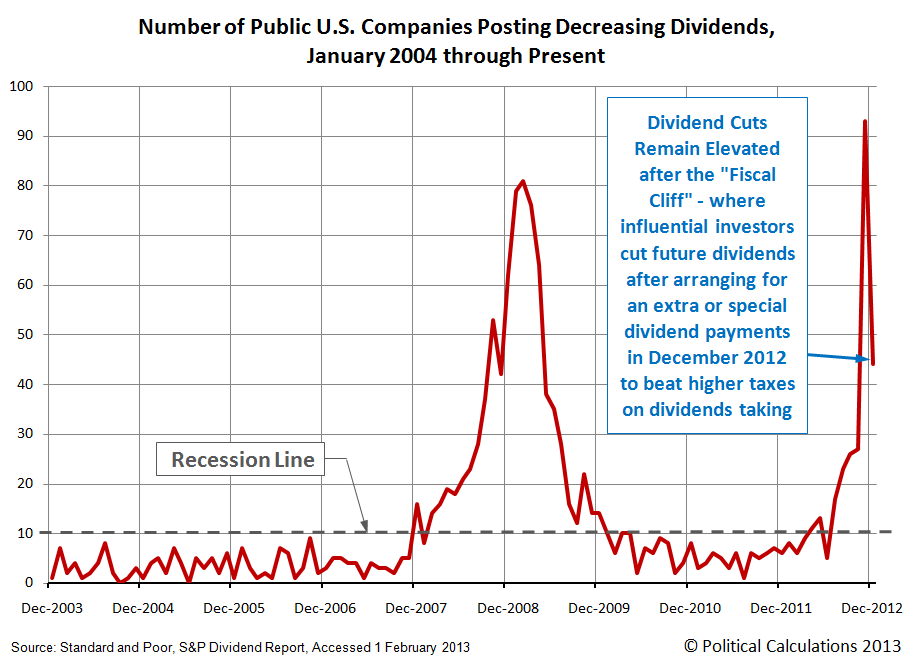
After spiking to a level higher than those recorded during the so-called "Great Recession" in the month of December 2012 in response to President Barack Obama's re-election and the corresponding guarantee of higher tax rates being imposed upon dividends, the number of publicly-traded U.S. companies acting to cut their future dividends remained elevated in January 2013.

Number of Public U.S. Companies Posting Decreasing Dividends, January 2004 through Present

Overall, some 44 companies acted to reduce their future dividend payments in January 2013 - well above the 10-per-month figure that would indicate that recessionary conditions are affecting the U.S. economy.

Taking into account the poor GDP performance of the U.S. economy in the fourth quarter of 2012, we should note that this indicator provided one of the earliest signals that the U.S. economy would be entering a period of near or outright contraction toward the end of 2012.

We do recognize however that this signal was affected in December 2012 by what we would describe as a "noise event, in this case, driven by influential investors at a large number of publicly-traded companies who responded to President Obama's re-election and the corresponding guarantee of higher tax rates being imposed upon dividends by either accelerating future dividend payments into 2012 or by making special or extra dividend payments before those higher tax rates might take effect in 2013.

Since many of these companies would then not be able to pay out the level of dividends in 2013 that they had previously promised after making these special payments before the end of 2012, they used the opportunity of their announcements that they would pay out extra dividends to also announce cuts to their future dividends, which is why we see such a spike in these announcements in December 2012.

We suspect that the number of dividend cut announcements being made in January 2013 likely includes a number of these companies in a similar situation, who pulled the money they were setting aside to pay out in 2013 into December 2012 instead, but who delayed the announcement of future dividend cuts until this past month. We do expect the number of companies acting to cut their dividends will remain elevated through much of quarter, however we also note that these additional dividend cuts are coming on top of an already elevated figure due to the deterioration of the U.S. economy in the second half of 2012.

Looking at the other data in S&P's dividend action report [Excel spreadsheet], we find that January 2013 saw a record number of companies (263) announce dividend increases in January 2013. The previous record of 246 companies acting to increase their regular dividends in a single month was set in February 2007.

It occurs to us that this new record for the number of dividend increases in a single month might also be a consequence of the so-called "fiscal cliff" tax hikes.

To understand why, we have to consider the tax hike situation that many influential investors faced in December 2012. Here, unless the U.S. Congress and President Obama came to an agreement on setting dividend tax rates in 2013, dividends could have been taxed at a rate as high as 43.4% - the same as would apply for regular, previously untaxed income (dividends are paid out by companies after the net income from which they are paid have been subjected to corporate income taxes). It was the risk of being subjected to a tax rate nearly three times as high as the 15% dividend tax rate that applied in 2012 that drove much of the year-end activity related to dividends in 2012.

But a deal was struck between Congress and the President early in January 2013, which set the effective tax rate for both dividends and capital gains at 23.6%. That tax rate is much lower than the 43.6% rate that applies to top income earners, which now provides an incentive for these high-income earning individuals to receive a larger share of their payments in the form of dividends from their companies (these the the influential investors to whom we keep referring!) And that's why we're now seeing a record number of dividend increases.

We expect that this quarter will be less interesting that 2012-Q4, but more interesting than average where dividends are concerned....

Jumat, 01 Februari 2013

New Jobless Claims: Totally Expected and What to Expect Next

As we expected, the number of new jobless benefit claims jumped from the low level reported in the previous week. Let's show where things stand now, then get to some analysis - our chart below shows where we are with respect to the most recently established trend for new jobless claims:

Closeup of Residual Distribution for Seasonally-Adjusted Initial Unemployment Insurance Claims Filed Weekly, 19 November 2011 to 26 January 2013

Now for analysis! The LA Times' Jim Puzzanghera reports:

The number of people filing for unemployment benefits for the first-time increased to 368,000 in the week ending Saturday, up from the previous week's level of 330,000, the Labor Department said Thursday. That figure was the lowest in five years.

Economists had speculated the sharp drop earlier in January could have been related to the difficulties of making seasonal adjustments after the holidays and at the start of a new year. Last week's increase could be offsetting overstated decreases.

Ah yes. The difficulties of making seasonal adjustments related to the timing of the Christmas and New Years' holidays. Because some speculating economists just never know what days of the week those events might fall upon from year to year, which in their minds means the data jocks at the BLS who have actually worked out the seasonal adjustment factors using years of data can't possibly account for these seemingly random events on the calendar.

But what level of jobless claims did the speculating economists expect? Reuters captures their expectations:

The number of Americans filing new claims for unemployment benefits bounced off five-year lows last week, pulling them back to levels consistent with modest job growth.

Initial claims for state unemployment benefits increased 38,000 to a seasonally adjusted 368,000, the Labor Department said on Thursday. The prior week's claims figure was unrevised.

Economists polled by Reuters had expected claims to increase to 350,000.

So they were off, but then those speculating economists blamed those pesky seasonal adjustments again:

Claims have been very volatile this month, dropping sharply in the week ended January 12 and maintaining the trend in the following week. That was largely because the model used by the department to smooth out the seasonal variations has been unusually generous during the first three weeks of January.

The volatility in the so-called seasonal factors has to do with the timing of holidays and when the weekends. The January calendar this year is aligned to 2008 and claims have generally followed a similar pattern.

Now, that's something we can check! First, we used Zeller's Algorithm to find the preceding two years in which Christmas fell on a Tuesday, just as it did in 2012, which of course is followed by New Years Day, again on a Tuesday, just a week later. Then we looked up the seasonal adjustment factors for the first four weeks of January that the BLS reported it used in each of those years. Our results are summarized in the table below:


Recent Seasonal Adjustment Factors for Years Where January 1 Falls on a Tuesday
Data for Week Ending200220082013
5 January160.4150.2148.6
12 January191.3171.5166.0
19 January137.9130.7132.3
26 January104.2100.699.5

Here, a seasonal adjustment factor of 100 would indicate that no adjustment for seasonality is made with the raw numbers of initial unemployment insurance claims filed that week. But what's important to recognize here is that the bigger the number, the bigger the size of the seasonal adjustment.

Looking at the data listed in our table above, we find that the seasonal adjustment factors for both 2002 and 2008, the two most recent years in which both Christmas Day and New Years Day fell on Tuesdays before they repeated that feat now in 2013, were far more generous in the size of their adjustments than were the adjustments made for 2013's raw figures.

It looks like some speculating economists aren't getting either their calendars or their facts straight!

Now, let's directly compare the factors for 2008 with 2013. Here, we find that the seasonal adjustment factors for the first, second and fourth weeks of January would be more generous in lowering the number of seasonally-adjusted claims reported in 2008 as compared to 2013. Only the data for the third week of January in 2013 would be more generously adjusted than the same data would have been in 2008.

Let's next see how that played out with respect to each week's news of the reported number of new jobless claims in both 2008 and 2013:


Initially Reported Change in New Jobless Claims and News Headlines for 2008 and 2013
Data for Week Ending20082013
5 January-15,000: U.S. Initial Jobless Claims Fell 15,000 to 322,000+4,000: Jobless Claims in U.S. Unexpectedly Increased Last Week
12 January-21,000: U.S. Initial Jobless Claims Unexpectedly Decline-37,000: Jobless Claims in U.S. Fell to Lowest Level in Five Years
19 January-1,000: U.S. Initial Jobless Claims Dropped 1,000 Last Week-5000: Jobless Claims in U.S. Decrease, Prolonging Seasonal Swings
26 January +69,000: U.S. Initial Jobless Claims Rose to 375,000 Last Week+38,000: Jobless Claims in U.S. Rose 38,000 Last Week to 368,000

In January 2008, the U.S. economy had begun falling into recession after the nation's economic expansion peaked in December 2007. As you might expect, the number of new jobless claims being filed in those early weeks of January 2008 reflected that strength, with the number decreasing in those weeks. Typically, it takes two to three weeks, a full payroll cycle, for a change in economic circumstances to show up in the new jobless claims data, so that's why the first indication that the U.S. was really falling into recession during this time didn't show up in the new jobless claims data until the fourth week of January 2008.

Flashing forward to 2013, we find that 2012 ended on a similar strong note. Here, oil and gasoline prices in the U.S. fell in the last weeks of December to be below $3.25 nationally, and in many regions of the country, retail prices at the pump dropped to or below $3.00 per gallon, which would be a key psychological threshold for U.S. consumers. When prices drop to that level, especially after having been elevated above that level for a prolonged period of time, the psychological effect combined with lower gasoline prices would provide a boost to the economy, as consumers now have both more money to spend on other things along with greater confidence. One full payroll cycle or 2-3 weeks later, that combination of positive factors shows up in much lower numbers of layoffs that are sustained over at least two weeks, until something changes.

Gas Prices Nearly at $4.84 per Gallon - Source: Powerline

And there the similarity between 2008 and 2013 ends, because on 1 January 2013, President Obama's stimulus Social Security tax cut expired, reducing the take home pay of all working Americans by a full two percent of their income, just as he desired.

What would that sudden reduction of 2% of their income mean in terms of gasoline prices for the typical American household?

Here, we turned to the 2011 Consumer Expenditure Survey, which tells us that an average American household with wage and salary income $49,805 in 2011, which we note is nearly equal to 2011's median household income of $50,054, spent $2,655 for gasoline and motor oil for transportation.

At 2011's average price of gasoline of $3.52 per gallon (or $3.65 in 2012 U.S. dollars), that works out to be just over 754 gallons of gasoline consumed in 2011. Since the average price of gasoline in 2012 was $3.63 per gallon, we can safely assume that U.S. households consumed a similar amount of gasoline in 2012 as they did in 2011.

Now, here's where it gets interesting. For a typical American household, President Obama's desired 2% Social Security tax increase would reduce their take home pay by nearly $1000. If we add that figure to the $2,655 that the typical American household spent on gasoline and motor oil in 2011 (and 2012), assuming they consumed the same 754 gallons of fuel, the effect on the economy would be the same as if the cost of gasoline at the pump suddenly spiked upward to $4.84 per gallon.

That's quite a lot higher than the $4.00 per gallon level that gasoline prices spiked higher to hit and surpass in April 2008, which is the event that firmly pushed the United States economy into recession, which then led to the failure of two-thirds of the nation's automotive industry at the end of 2008 and beginning of 2009.

At this point, we've only seen about half the initial impact of that change, as the new jobless claims numbers for the week ending 26 January 2013 are just reflecting the period into the second week of January. Given the delay in when most companies would be adjusting their paycheck tax withholding related to the fiscal cliff debate at the beginning of the year, the effect of President Obama's desired 2% tax hike on all wage and salary-earning Americans will continue to play out over the next several weeks.

So you can expect the number of new jobless claims to increase in the weeks ahead. At least you can't say that the numbers are unexpected!

Image Source: Powerline.